What Makes an Oral Dissolving Sleep Aid Work Faster Than a Pill
Discover why oral dissolving sleep aids work faster than pills. Learn how sublingual absorption beats swallowing for quicker results.
You're tired. It's 10 pm. The last thing you want to do is fill a glass of water, tilt your head back, and try to convince your throat to swallow a chalky tablet. And then wait. And wait some more.
In 2024, 30.5% of American adults slept fewer than 7 hours per night, and 15.4% had trouble falling asleep on most days. That's tens of millions of people with a real, nightly problem who are reaching for sleep supplements in record numbers. The question isn't really whether to use a sleep aid, it's whether the format you're using is actually built for the job.
A pill and an oral dissolving strip are not the same thing dressed differently. How the active ingredient gets to work matters. This article breaks down exactly what happens when you place a dissolving film on your tongue, why it's a different experience than swallowing a capsule, and how the 30-minute window before bed changes everything.
Key Takeaways
The pill has to travel first. A standard sleep supplement capsule or tablet has to survive your stomach and digestive system before it does anything. Melatonin in tablet or capsule form generally has low bioavailability, as little as 15% on average according to a University of Copenhagen systematic review, and the number varies widely by individual. If you're not seeing results from your current pill, that's worth knowing.
Dissolving films absorb under the tongue. Quick-dissolving oral strips are ultra-thin sheets that deliver active ingredients through the mouth's mucosal lining. They melt on the tongue without the need for water, making them a convenient and fast-acting alternative to pills, gummies, and powders.
Timing changes the outcome. Experts in sleep medicine recommend starting your wind-down time 30 minutes to two hours before your intended bedtime. Taking a dissolving strip at the start of that window lines up the format with how sleep actually works.
Forty percent of Americans struggle with pills. Up to 40% of American adults have reported difficulty swallowing pills, and older adults are more susceptible because they take more medications. A format that skips swallowing entirely removes a real barrier.
Shutdown, not sedation. An oral dissolving sleep strip is designed to support a natural wind-down. It signals your system to quiet down; it does not knock you out.
Quick-Start Prioritization Framework
| Format | Best For | Effort Level | Time to Results |
|---|---|---|---|
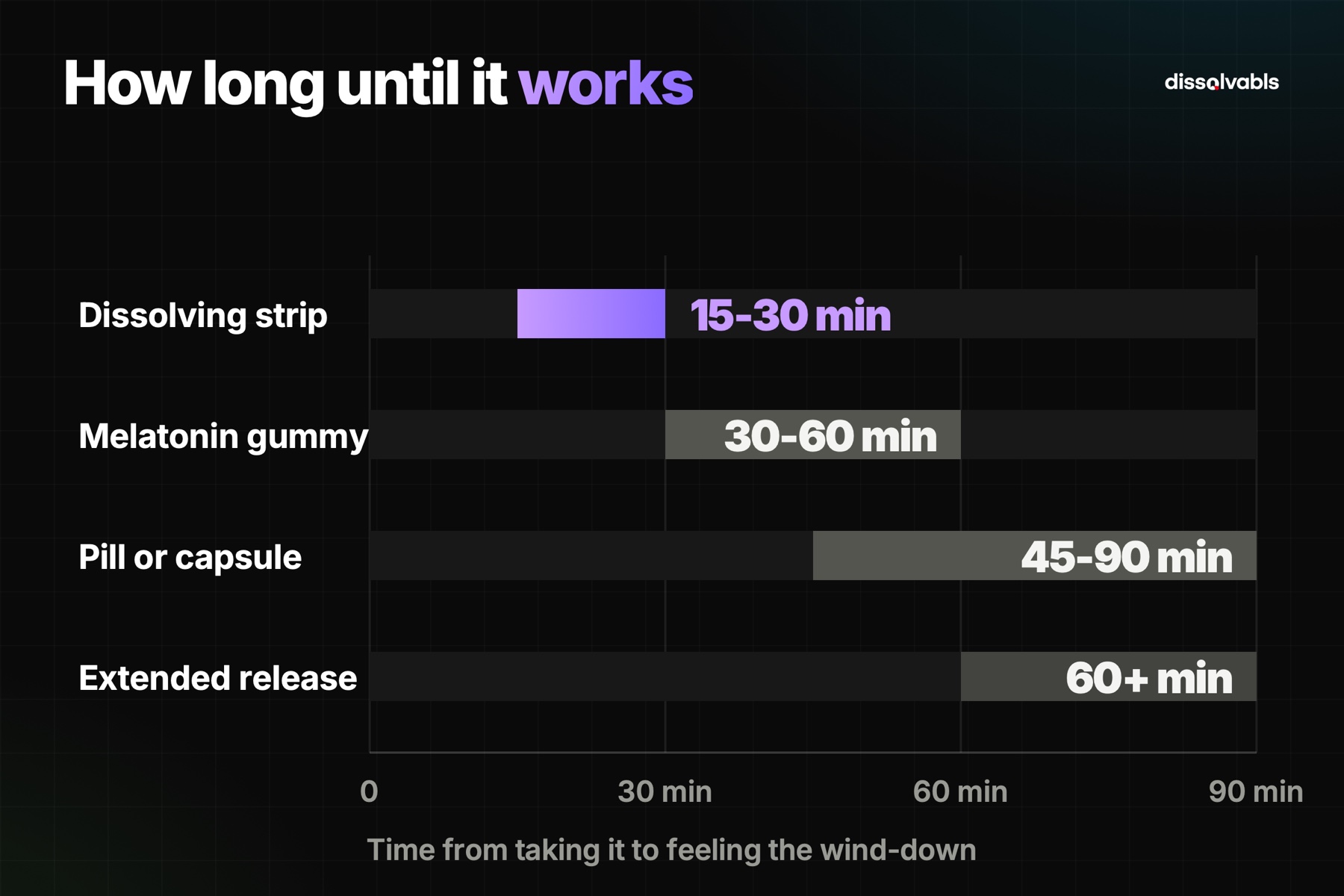
| Oral dissolving strip | Anyone who wants no-water, fast-absorbing support | Low | 15-30 minutes |
| Melatonin gummy | Those who prefer a familiar, chewable format | Low | 30-60 minutes |
| Standard capsule/tablet | Budget-conscious buyers okay with waiting | Low | 45-90 minutes |
| Extended-release tablet | People focused on staying asleep, not falling asleep | Low | 60+ minutes |
Start here if you are:
A doer who's already in bed mode at 10 pm: The strip, place it on your tongue while you dim the lights and reach for your book.
Someone who hates swallowing pills: The strip requires no water, no head-tilting, no gagging.
Building a consistent wind-down routine: Pair the strip with your first calm activity at the 30-minute mark before bed and let it work alongside the routine.
Why a Standard Sleep Pill Takes So Long
The Digestive Route Is a Long Route
When you swallow a melatonin tablet, it starts a journey. It moves down your esophagus, into your stomach, and then into your small intestine. Only after that process completes does any active ingredient make it into your system. With most oral preparations, it can take more than 30 minutes, and in some cases upwards of an hour, for melatonin's concentration to reach its peak after you've swallowed it.
That delay matters. If you take a standard tablet at 10:00 pm and it peaks at 11:15 pm, you may have spent over an hour lying in bed frustrated, wondering why you're not feeling anything yet.
Bioavailability Is Lower Than You Think
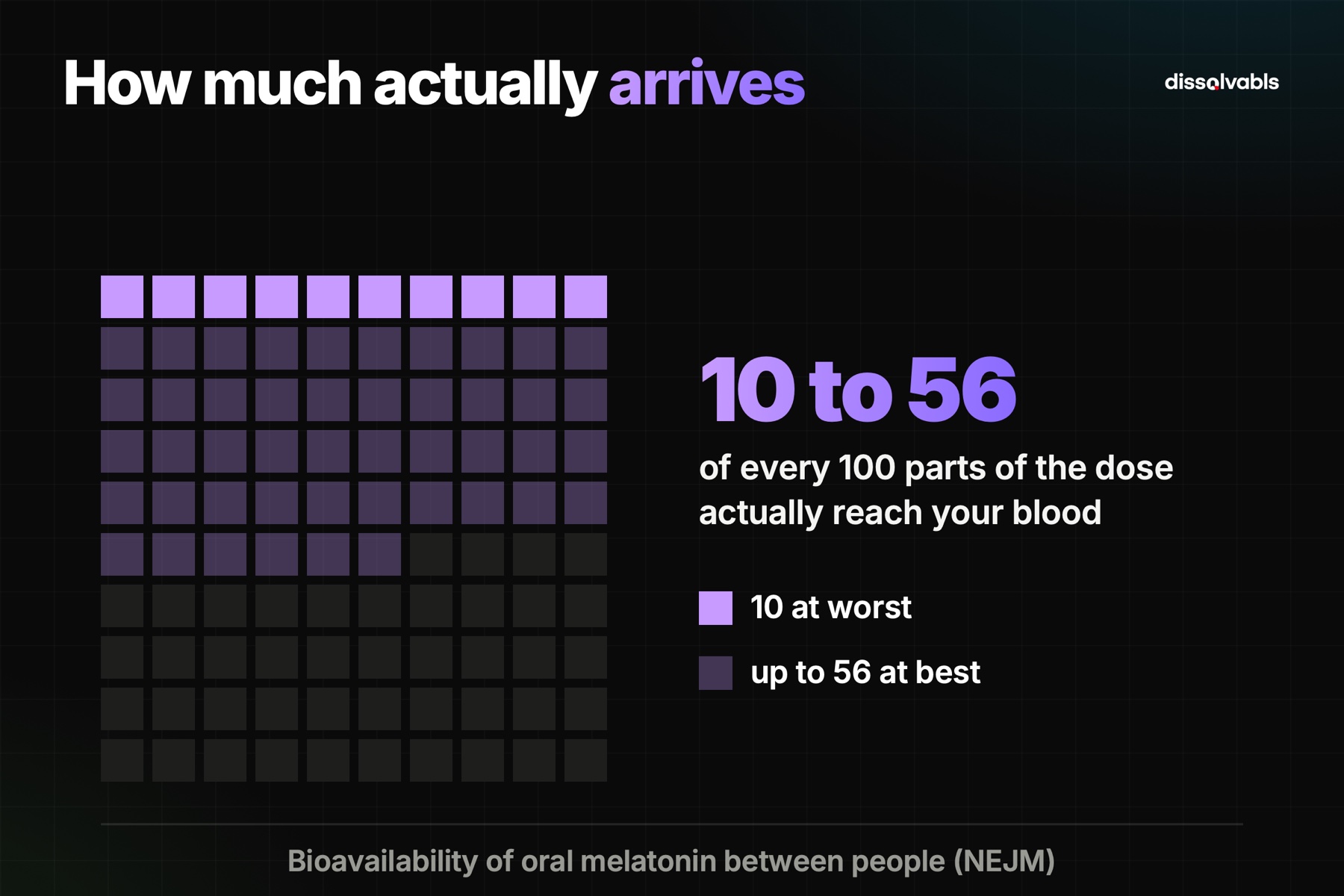
Here's the part the label doesn't spell out: the bioavailability of oral melatonin was found to be poor (averaging around 33%) and varying widely between individuals, ranging from 10% to 56%. That variability is the problem. Two people can take the exact same dose from the exact same bottle and have completely different experiences, because their digestive systems process it differently.
Oral melatonin has been studied to reach peak plasma concentration after approximately 41 minutes of administration, and its pharmacokinetics varied greatly between individuals. Because of this well-recognized low bioavailability, researchers are actively developing formulations that bypass the gastrointestinal tract. The oral dissolving strip is one of those formulations.
Pro tip: If you've tried a standard melatonin pill and thought it "didn't work," the issue may be bioavailability, not the compound itself. The format matters as much as the ingredient.
Swallowing a Pill at Night Is Inconvenient by Design
Up to 40% of American adults have reported difficulty swallowing pills. That's not a small group. Of those who experience difficulty swallowing their medications, 14% have delayed taking doses, 8% have skipped a dose entirely, and 4% have discontinued using the supplement altogether.
Skipping your sleep supplement because you don't feel like fighting with a glass of water at 10 pm is a real pattern. The format is working against you.
How an Oral Dissolving Strip Actually Works
The Mucosal Tissue Under Your Tongue
Dissolving strips, including Dissolvabls' Sleep Que-Strips, are thin films designed to melt in 10 to 15 seconds when placed on the tongue. The active ingredients then absorb through the mucosal tissue under the tongue, which is dense with capillaries sitting close to the surface.
The sublingual route of absorbing medication is an alternative to the traditional oral route. A drug may be taken sublingually specifically when it needs to get into your system quickly. That's the core design principle behind the format.
When comparing traditional oral versus sublingual medications, sublingual medications start to work faster than traditional oral medications, and they do not have to pass through your gastrointestinal tract or liver first.
The 10-to-15-Second Melt
This is where the format diverges most from a gummy or a pill. You don't swallow it. You don't chew it. You place it on the tongue, and it's gone in about 15 seconds. In the case of Dissolvabls' Sleep Que-Strip, that means valerian, L-theanine, chamomile, passion flower, ashwagandha, melatonin, and vitamin B6, all absorbing under the tongue from there.
Oral strips are typically absorbed in 1 to 5 minutes, while pills may take 20 to 30 minutes or more to break down in the digestive system. That gap is the reason people who switch formats often report that the strip "feels faster." It is faster.
Pro tip: There's no right or wrong position for using a dissolving strip, but holding it still under your tongue for a few seconds and resisting the urge to swallow early gives it the best chance to absorb fully. Treat it like a pause, not a task.
Why No Water Is a Bigger Deal Than It Sounds
Needing water to take a pill sounds minor until it's 10:15 pm and you're already horizontal. You either get up, or you skip it. Unlike pills, which require swallowing and digestion, oral strips dissolve quickly on the tongue without the need for water. That single feature removes the friction point that causes most late-night supplement skipping.
The 30-Minute Wind-Down Window
Sleep Is a Process, Not a Switch
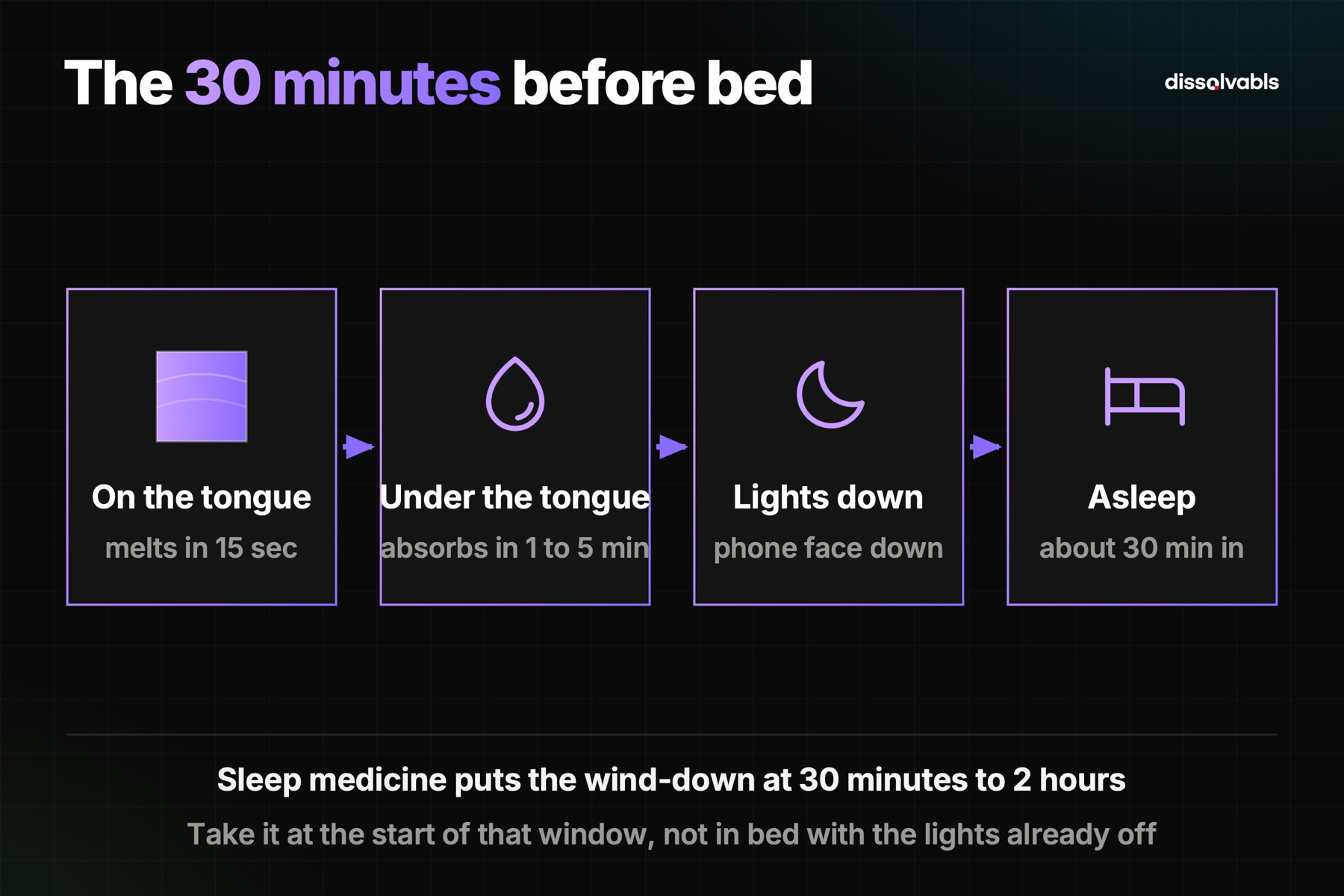
This is the piece most people miss. Your body does not switch from "fully awake" to "asleep" in an instant. Experts in sleep medicine recommend starting your wind-down time 30 minutes to two hours before your intended bedtime. Research suggests that aligning your wind-down routine with your circadian rhythm can significantly improve your ability to fall asleep fast and stay asleep.
An oral dissolving sleep strip fits naturally into the start of that window. You place it on your tongue, it absorbs in seconds, and you move into your first quiet activity, dimming lights, putting down your phone, settling in. By the time you're ready for sleep, the strip has already done its part.
Light and Melatonin Work Together
Blue light from phones, tablets and computers can delay the release of melatonin, your body's sleep-inducing hormone. An "electronics curfew" one hour before bedtime helps your body begin its natural descent into nighttime sleep.
Pairing a dissolving sleep strip with screen reduction makes the wind-down more effective. You're not just adding a supplement, you're removing something that works against your body's natural rhythm at the same time.
Lavender and the Nervous System
Dissolvabls' Sleep Que-Strip is lavender-flavored, which is a considered choice. Among essential oils, few have been studied as much as lavender. Lavender has been associated with improved sleep in multiple research studies.
Lavender essential oil contains over 100 compounds, but two stand out for sleep benefits: linalool and linalyl acetate. Linalool, comprising 25 to 38% of lavender oil, acts as a sedative and anxiolytic agent. Research demonstrates that linalool interacts directly with neurotransmitter receptors in the brain, particularly the GABA system.
The scent alone carries a signal. Even the act of placing a lavender strip on your tongue cues your brain that shutdown is starting.
Pro tip: Use the moment you place the strip on your tongue as your official "done for the day" signal. Put the phone face-down. That pairing, strip plus ritual, builds consistency faster than either one alone.
Dissolving Strip vs. Gummy vs. Pill: An Honest Comparison
What Each Format Actually Delivers
Oral Dissolving Strip:
Pros:
Absorbs under the tongue, no water needed
10-to-15-second melt, minimal effort at night
No need to get up for a glass of water
Compact and portable
Cons:
Less widely available than gummies or pills
A few seconds of patience required while it dissolves
Melatonin Gummy:
Pros:
Familiar, pleasant format
Widely available
Cons:
Gummies must pass through the stomach and liver first, meaning the onset is slower, typically 30 to 60 minutes after ingestion
Many gummy formulas include sugar or flavoring that can interfere with nighttime glucose stability or dental hygiene if used close to bedtime
Standard Pill or Capsule:
Pros:
Low cost, familiar format
Extended-release options available
Cons:
Requires water, which means getting up if you forgot
55% of people have experienced difficulties swallowing medications at some point in their lives
Low and variable bioavailability, as noted above
What to Ignore When Comparing
Format marketing often focuses on dose size. Bigger number, better sleep, right? The New England Journal of Medicine's research on oral melatonin found that peak concentrations varied widely among individuals from the same dose, suggesting the delivery method shapes the outcome as much as the milligrams do. Bigger dose in a low-bioavailability format may simply mean more waste.
Common Mistakes That Undercut Your Sleep Supplement
Taking It Too Late
Most people take a sleep supplement when they're already in bed with the lights off. That's the wrong timing. Most people take melatonin right before they turn off the light, but research consistently shows this is too late. A 2024 systematic review of 26 randomized controlled trials found that taking melatonin 2 to 3 hours before bedtime reduced sleep onset latency significantly more than the standard 30-minute window used in most clinical practice.
For a nightly dissolving strip used as part of a wind-down, aim for 30 minutes before bed at minimum. Use it as the starting gun for your quiet hour, not the finish line.
Keeping Screens On After You Take It
You've taken your strip. You've signaled to your body that sleep is coming. Then you spend 45 minutes scrolling. Bright light serves as a natural cue to your body that it's time to wake up. In the evening, it delays melatonin production, which in turn delays your sleep window. As such, limiting light exposure during your wind-down routine is important.
Combine the strip with screen reduction. That combination moves faster than either alone.
Expecting Sedation
A sleep strip is a shutdown signal, not a sedative. Dissolvabls says it plainly: Sleep Que-Strips are a shutdown, not sedation. You'll feel the wind-down. You won't feel knocked out. If you're looking for that heavy, pharmaceutical-grade feeling, that's a different product category entirely. What you get with a dissolving strip is a gentler, more natural transition, your body quieting down on a prompt, not a command.
Frequently Asked Questions
How long does it take for an oral dissolving sleep strip to start working?
The strip itself dissolves in 10 to 15 seconds. The active ingredients, including valerian, L-theanine, and melatonin, absorb under the tongue from there. Oral strips are typically absorbed in 1 to 5 minutes, compared to 30 minutes or more for a standard pill. Most people notice the wind-down effect beginning within 20 to 30 minutes, which is why placing it at the start of your pre-bed routine works well.
Do I need water to use a dissolving sleep strip?
No. Unlike pills, which require swallowing and digestion, oral strips dissolve quickly on the tongue without the need for water. That's one of the primary advantages of the format, especially at night when getting up for a glass of water is a real friction point.
Can I use an oral dissolving sleep aid every night?
This is a question worth discussing with your doctor if you have any health conditions or take other medications. As a general note, the goal of a product like Dissolvabls' Sleep Que-Strip is to support a consistent wind-down routine rather than to treat a medical condition. It does not claim to treat insomnia. If you're relying on any sleep supplement every single night and still waking unrefreshed, the underlying sleep hygiene habits deserve a closer look alongside the supplement.
Is the lavender flavor in Dissolvabls' Sleep strip functional or just for taste?
It's there for the taste and for the ritual. Among essential oils, few have been studied as much as lavender for sleep, and the scent is a familiar cue that the day is over. The work itself is done by the formula: valerian, L-theanine, chamomile, passion flower, ashwagandha, melatonin, and vitamin B6.
What makes a dissolving strip different from a sublingual tablet?
Both formats absorb under the tongue. The key difference is texture and speed. A sublingual tablet is still a solid that takes several minutes to dissolve. A thin dissolving strip is formulated to melt in seconds. In vitro dissolution from rapid-release formulations can be substantially complete within 5 minutes, with some dissolving in as little as 30 seconds to two minutes. Dissolvabls' Que-Strips are engineered for 10 to 15 seconds specifically, that's a design choice, not a coincidence.
The Bottom Line
A sleep supplement that takes 45 to 90 minutes to peak, requires water to swallow, and may absorb erratically depending on what you ate for dinner is fighting uphill. A dissolving strip absorbs under the tongue in under a minute, requires no water, and can be taken as the first act of your wind-down routine rather than the last thought before you turn the lights out.
33% of American adults (around 84 million people), say their sleep is "fair" or "poor." If you're in that group, your supplement format is worth reconsidering before you increase the dose.
Dissolvabls' Sleep Que-Strip is a lavender-flavored thin film that melts in 10 to 15 seconds, contains melatonin alongside valerian, L-theanine, chamomile, passion flower, ashwagandha, and vitamin B6, and is backed by a 30-day money-back guarantee. Place it on your tongue at the start of your wind-down, put the phone down, and let the next 30 minutes be quiet. That's the format working as designed.
Sources
Short Sleep Duration and Sleep Difficulties Among Adults: United States, 2024, Centers for Disease Control and Prevention / NCHS. National Health Interview Survey data. https://www.cdc.gov/nchs/products/databriefs/db559.htm
Sublingual Medications: How They Work and Step-by-Step Guide, Healthline. Overview of sublingual absorption and administration. https://www.healthline.com/health/drugs/sublingual-and-buccal-medication-administration
When Pills Pose Problems, Harvard Health Publishing. Statistics and analysis on pill-swallowing difficulties in American adults. https://www.health.harvard.edu/healthy-aging-and-longevity/when-pills-pose-problems
Variable Bioavailability of Oral Melatonin, New England Journal of Medicine. Research on melatonin bioavailability variability. https://www.nejm.org/doi/full/10.1056/NEJM199704033361418
The Science of Absorption: How Quick-Dissolving Strips Work, Calmour. Comparison of oral strip vs. pill absorption speed. https://calmourhealth.com/blogs/news/the-science-of-absorption-how-quick-dissolving-strips-work
Melatonin Strips vs Gummies: Which Sleep Aid Works Faster?, Calmour. Onset comparison between strips and gummies. https://calmourhealth.com/blogs/news/melatonin-strips-vs-gummies-which-sleep-aid-works-faster-and-better
How to Wind Down Before Bed, Headspace. Sleep medicine expert guidance on wind-down timing. https://www.headspace.com/articles/sleep-health-3-how-to-build-a-perfect-wind-down-routine
What Time of Day Is Best to Take Melatonin?, Bio Absorb Nutraceuticals. 2024 systematic review data on melatonin timing. https://www.bioabsorbnutraceuticals.com/blogs/melatonin/what-time-of-day-is-best-to-take-melatonin
Bioavailability of Melatonin, Phytomelatonin.org. University of Copenhagen systematic review on oral melatonin bioavailability. https://www.phytomelatonin.org/bioavailability
Difficult Pill to Swallow: Investigation of Medication Swallowing Difficulties, Taylor and Francis / Patient Preference and Adherence. Swallowing difficulty frequency data. https://www.tandfonline.com/doi/full/10.2147/PPA.S277238
How Smell Affects Your Sleep, Sleep Foundation. Research on lavender and sleep quality. https://www.sleepfoundation.org/bedroom-environment/how-smell-affects-your-sleep
The Science Behind Lavender for Better Sleep, Lavender Life Company. Linalool, GABA, and lavender compound research. https://lavender-life.com/blogs/comfort-emotional-wellness/the-science-behind-lavender-for-better-sleep-what-research-really-says
Wind-Down Time: The Key to Healthy Natural Sleep, Rise Science. Circadian rhythm and wind-down timing guidance. https://www.risescience.com/blog/wind-down-time
110+ Sleep Statistics and Facts, NapLab. US adult sleep quality survey data. https://naplab.com/guides/sleep-statistics/
Sublingual or Buccal Administration of Melatonin, USPTO Patent No. 10,500,190. Melatonin dissolution research and mucosal absorption data. https://image-ppubs.uspto.gov/dirsearch-public/print/downloadPdf/10500190