Two Switches: The 12 Hours Nobody Programs
Elite athletes master training but ignore the 12 hours that matter most. How sleep and athletic performance create or destroy recovery.
You left everything on the field. Or in the boardroom. Or both; it was that kind of Tuesday. The recital is at seven. The term sheet needs twenty minutes you do not have. There is a decision in the inbox that only you can make, and your body is running on whatever you had at noon.
That is the 5pm problem. The on switch is stuck.
Then there is the 1am version. Game ended at 11:04 Eastern. Media done, cold tub done, body finished. The nervous system has not been told. You are in a hotel bed in a city you leave in six hours and your brain is still running the third quarter, cataloguing every missed assignment, every decision under pressure.
That is the other switch. The off switch. And nobody programmed it.
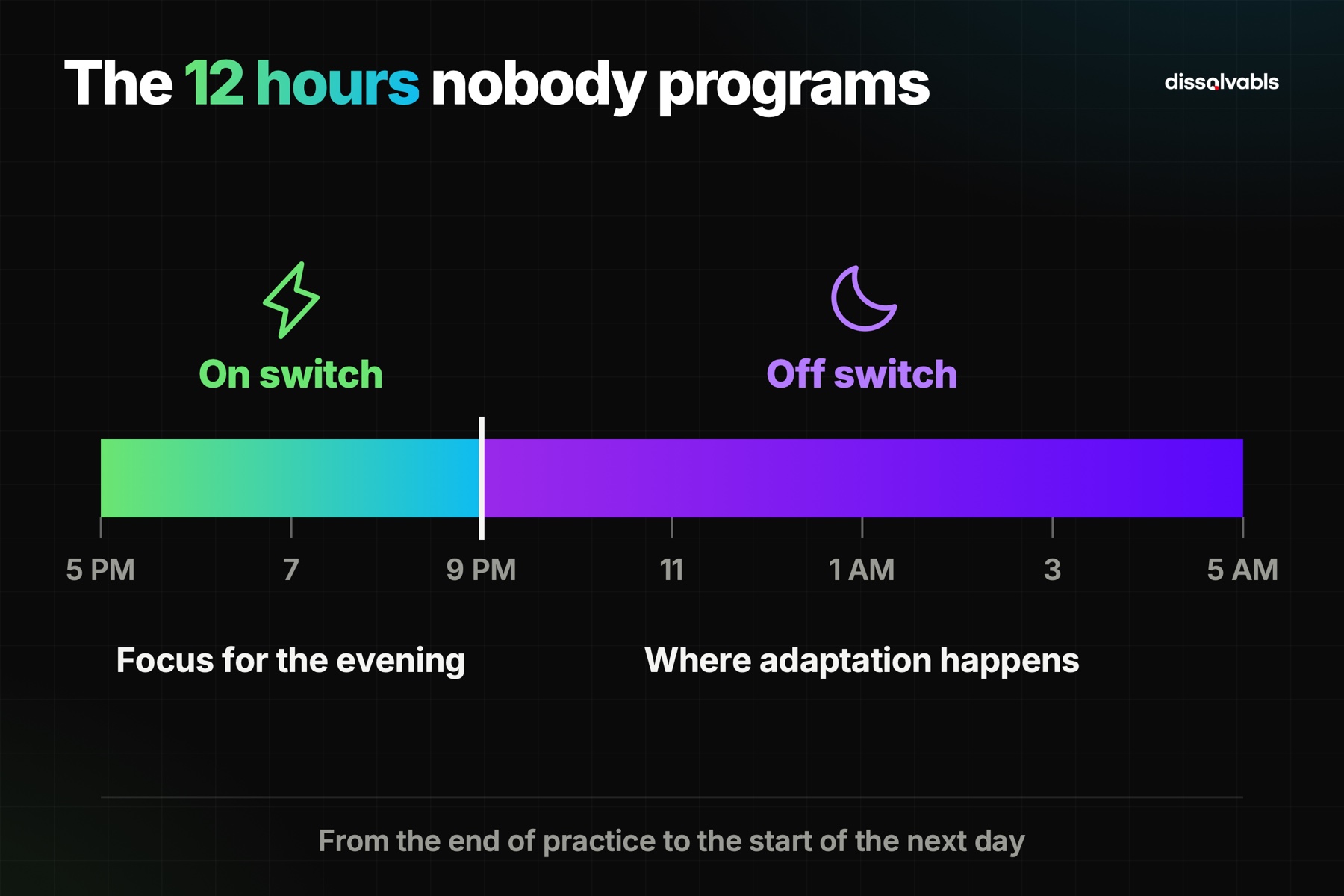
Here is the thing: there is a coach for the lift, a trainer for the ankle, a nutritionist for the plate, and a film room for the mistakes. The twelve hours between the end of practice and the start of the next day, the hours that actually determine whether the work holds, belong to no one.
Key Takeaways
The sleep deficit is structural, not personal. More than 60% of elite athletes report insomnia the night before competition, according to research published in Practical Neurology, and the lifestyle itself, travel, variable schedules, injury, stacks the odds against rest. Build the off switch before you need it.
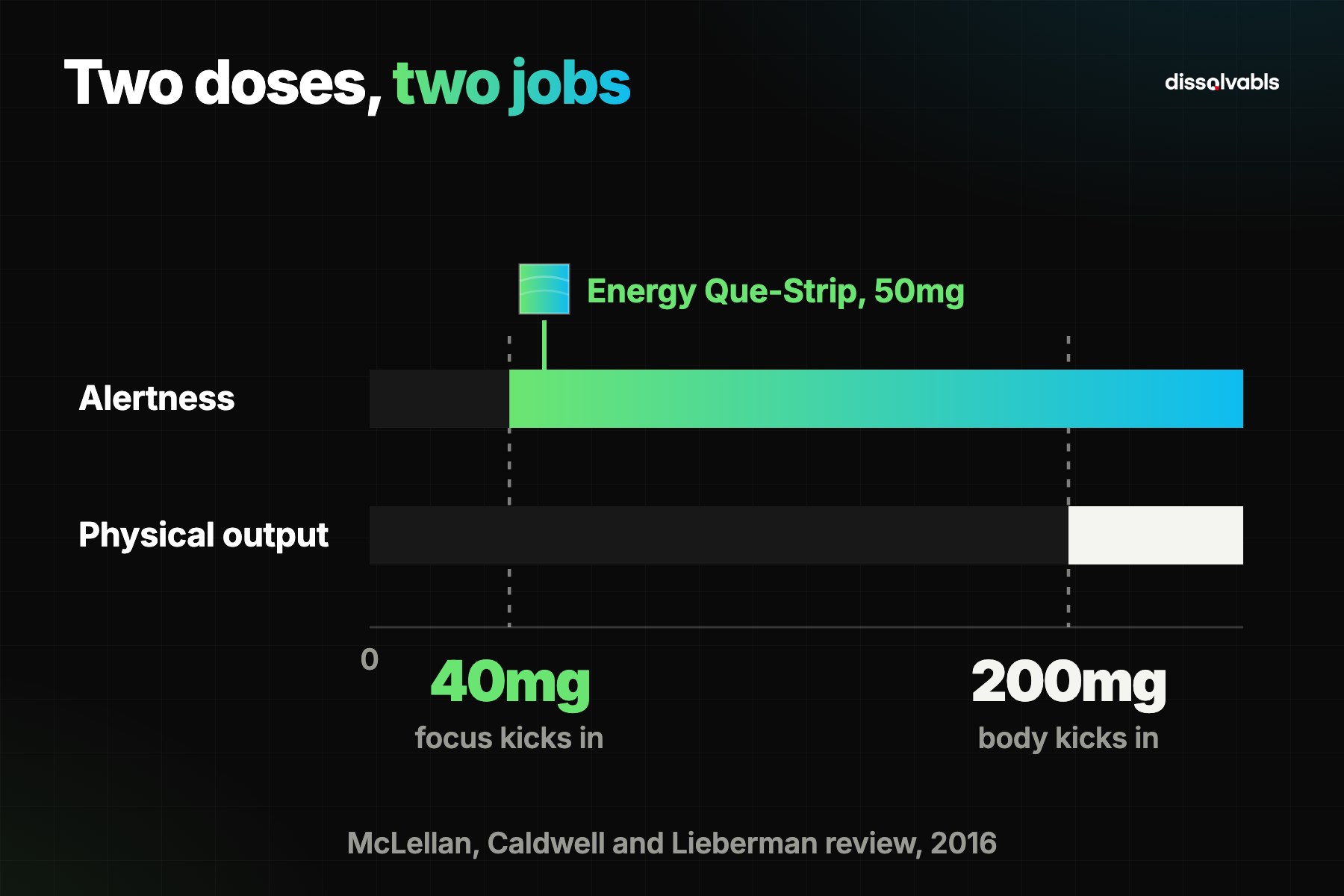
Dose separates alertness from physical performance. The McLellan, Caldwell and Lieberman review in Neuroscience and Biobehavioral Reviews found that low doses of caffeine (starting around 40mg) improve alertness, vigilance, and reaction time, while effects on physical output do not appear until doses exceed roughly 200mg. The right amount at 5pm is a precision tool, not a hammer.
Sleep debt compounds into injury. In an adolescent athlete sample those sleeping under 8 hours a night were 1.7 times more likely to sustain an injury, meaning this is a tissue and tendon issue, not just a mood issue.
The twelve hours are the training. Recovery is where adaptation happens. Treating the transition hours as dead time is leaving the session unfinished.
The On Switch: How Much Caffeine the Second Switch Actually Needs
3 out of 4 elite athletes use caffeine before or during competition. The Del Coso et al. study in Applied Physiology, Nutrition, and Metabolism measured caffeine concentration across 20,686 post-competition urine samples and found 73.8% contained caffeine, while only 0.6% of samples came anywhere near the former doping threshold. Every serious doer is already using it. The question is when, how much, and what for.
Dose Is the Decision
The McLellan, Caldwell and Lieberman review in Neuroscience and Biobehavioral Reviews found that from approximately 40mg upward, caffeine sharpens alertness, vigilance, attention, and reaction time. Physical output effects on metrics like time-to-exhaustion and high-intensity sprints appear at doses exceeding roughly 200mg.
That gap matters. The 5pm problem is not a physical output problem. It is a focus problem, a presence problem, a "how do I give the next 2 hours to the people who need them" problem.
That lives in the 40mg range. The Energy Que-Strip from Dissolvabls carries exactly 50mg of natural caffeine from green coffee, plus 30mg L-theanine and 20mg ginseng. It absorbs under the tongue. There is no water, no pill, no guessing the dose.
Think of it like this: about half a cup of coffee, sharpened for the next hour. Not an all-day solution. Not a pre-workout. The finish line product for the stretch between the gym and the dinner table.
The Off Switch: What the Research on Sleep and Athletic Performance Actually Shows
The numbers here are not motivational. They are structural.
The Circadian Data
A study by Harvard and Stanford researchers published in the journal Sleep found that over 40 years of NFL night games starting after 8pm Eastern, West Coast teams beat the point spread at roughly twice the rate of daytime controls, even after accounting for team quality. The researchers concluded that circadian alignment was the mechanism. A West Coast team playing at 8pm Eastern is competing at what their internal clock reads as 5pm, close to the natural athletic peak. The East Coast team is competing past their biological bedtime.
That is a scoreboard effect from sleep timing alone.
The Extension Data
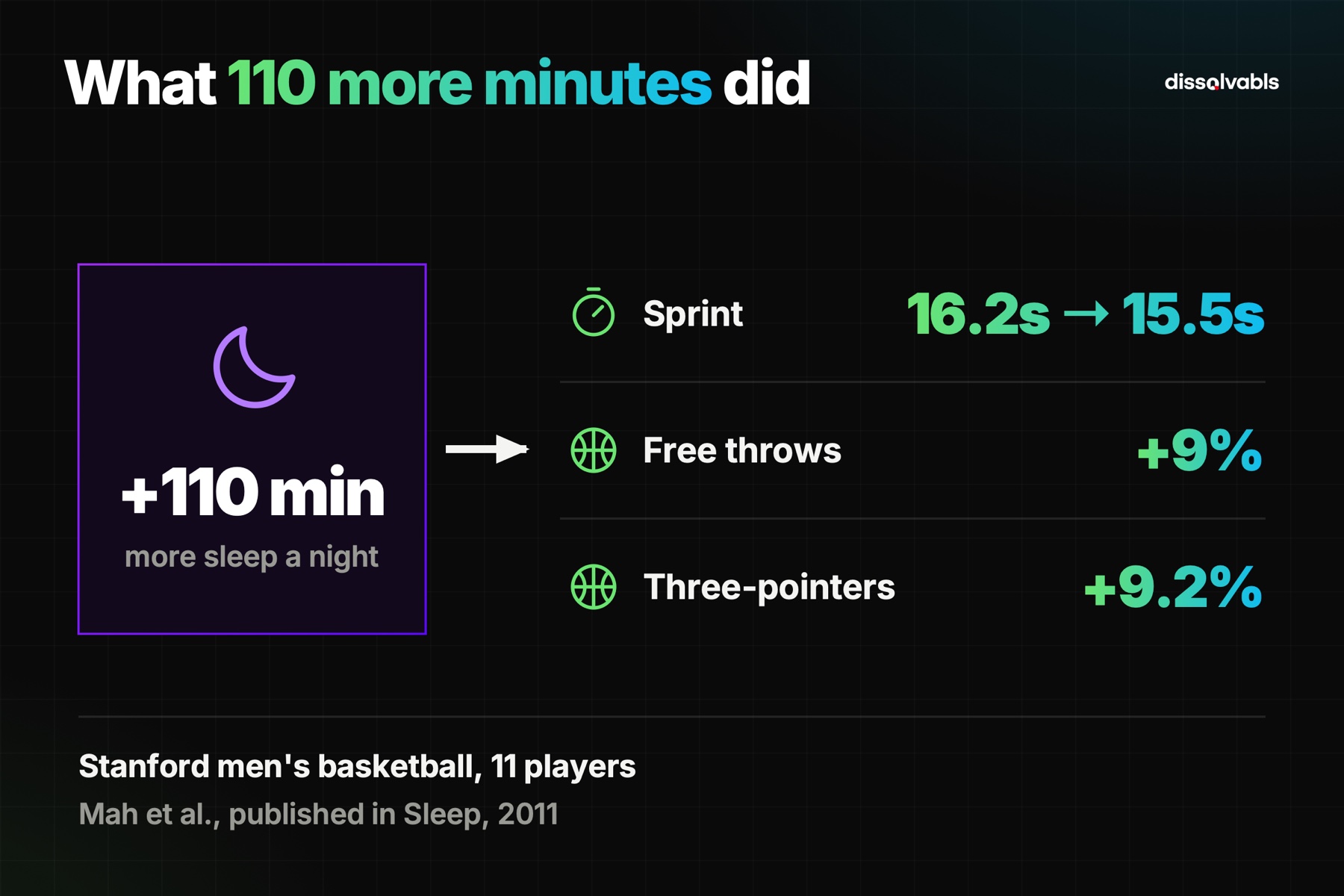
The Mah et al. study published in Sleep followed 11 players on the Stanford University men's varsity basketball team. Sleep was extended by an average of 110 minutes a night. Sprint times improved from 16.2 to 15.5 seconds. Free throw accuracy improved by 9% and three-point accuracy by 9.2%. More sleep, faster and more accurate. That is not a correlation. That is a controlled intervention with objective performance metrics.
The Injury Data
A study by Milewski and colleagues published in the Journal of Pediatric Orthopaedics gathered sleep habits and injury records from adolescent athletes over 21 months and found those averaging under 8 hours a night were 1.7 times more likely to have sustained an injury. This was an adolescent sample, but the mechanism, impaired motor coordination, slower reaction time, degraded tissue repair, does not stop at 18.
If you are sleeping under 8 hours and wondering why the ankle keeps flaring, sleep is a reasonable first variable to examine.
What the 12 Hours Are Actually For
Nobody outside your building sees them.
The recital happens whether you are present or just in the room. The term sheet gets signed either way; whether you read it properly is a separate question. Your friend flies home Sunday.
Your kid will not remember the third quarter. She will remember whether you looked at her.
That is the case for treating those twelve hours as part of the program instead of the wreckage left over after it. Not because you owe anyone more output. Because the sport ends and the rest of it does not.
The investor, the parent, the partner, the friend. Those are not the second-string versions of you. They are the ones still standing when the career is over.
One Day, Two Switches
You already solve hard problems with the right tool. You do not use a flat-iron to tape an ankle. You do not use a pre-workout scoop to wind down. The two ends of the twelve hours are different problems, so they get different tools.
The On Switch: The Energy Que-Strip is there for the moment the game ends and the rest of your life starts. 50mg of natural caffeine from green coffee, 30mg L-theanine, and 20mg ginseng: enough to be sharp, nowhere near the dose that does anything to your sprint. What it protects is not your energy. It is the recital you actually watch, the term sheet you actually read, the partner who gets your full attention instead of whatever is left. It empowers you to be the best parent, friend, and business partner you can be after you have left it all on the field.
The Off Switch: The Sleep Que-Strip is there for the moment the replays start. Melatonin, L-theanine, valerian, ashwagandha, chamomile, and vitamin B6, designed to help your body make the transition from game mode to rest. What it protects is tomorrow. The research above is clear about what a full night of sleep does for an athlete. The off switch is how you stop running the third quarter at 1am and give that night a chance to happen.
Two switches, 30 seconds each, for the 12 hours nobody writes a program for. The Dissolvabls Energy and Sleep Que-Strips Bundle puts both in one order: Energy for the start of the evening, Sleep for the end of the night.
The 30-day money-back guarantee means the only risk is a few weeks of actually sleeping and having the energy for the people you care about. You can review the evidence behind the new format at Dissolvabls' Research Page
Frequently Asked Questions
Will 50mg of caffeine actually do anything?
Yes, and that is exactly the point. The McLellan, Caldwell and Lieberman review confirms that even low doses starting around 40mg produce measurable improvements in alertness, vigilance, and reaction time. The Energy Que-Strip is built for the alertness range, not the physical-output range. It is calibrated for the parent-athlete who needs to be present from 5pm to 9pm, not the athlete warming up for a 200mg ergogenic effect on the field.
Why do elite athletes sleep so poorly if sleep is this important?
The Practical Neurology review notes that the elite-athlete lifestyle itself, frequent travel, variable schedules, injury or pain, creates structural conditions that predispose athletes to insomnia, on top of the pre-competition anxiety that over 60% report. The environment fights the biology. That is why the off switch has to be deliberate.
Is melatonin safe for regular use?
Melatonin is widely used as a sleep-support supplement, not a pharmaceutical sleep aid. The dose in the Sleep Que-Strip is designed as a timing signal, not a sedative. For anything related to a medical condition or prescription interactions, talk to your physician. The strip is not a treatment for any condition.
How do I know when to use energy versus sleep?
Use the Energy Que-Strip when the next two hours need you sharp and the day is not done. Use the sleep strip when you are ready to be done but the brain has not agreed yet. The transition between those two states is what the twelve hours are for.
You already gave everything to the game. Keep enough for the people who waited.
Sources
Prevalence of caffeine use in elite athletes following its removal from the WADA list, Del Coso, Muñoz, Muñoz-Guerra. Applied Physiology, Nutrition, and Metabolism, 2011. Del Coso et al. study in Applied Physiology, Nutrition, and Metabolism. https://pubmed.ncbi.nlm.nih.gov/21854160/
A review of caffeine's effects on cognitive, physical and occupational performance, McLellan, Caldwell, Lieberman. Neuroscience and Biobehavioral Reviews, 2016. McLellan, Caldwell and Lieberman review in Neuroscience and Biobehavioral Reviews. https://pubmed.ncbi.nlm.nih.gov/27612937/
The effects of sleep extension on the athletic performance of collegiate basketball players, Mah, Mah, Kezirian, Dement. Sleep, 2011. Mah et al. study published in Sleep. https://pmc.ncbi.nlm.nih.gov/articles/PMC3119836/
The impact of circadian misalignment on athletic performance in professional football players, Smith, Efron, Mah, Malhotra. Sleep, 2013. study by Harvard and Stanford researchers published in the journal Sleep. https://pmc.ncbi.nlm.nih.gov/articles/PMC3825451/
Chronic lack of sleep is associated with increased sports injuries in adolescent athletes, Milewski et al. Journal of Pediatric Orthopaedics, 2014. https://www.healio.com/news/orthopedics/20140217/more-sleep-may-help-prevent-athletic-injuries-in-adolescents
Sleep and elite athletic performance, Practical Neurology, 2019. https://practicalneurology.com/articles/2019-mar-apr/sleep--elite-athletic-performance
Does elite sport degrade sleep quality? A systematic review, Sports Medicine, 2016. https://link.springer.com/article/10.1007/s40279-016-0650-6