Tired but Wired: Why Your Body Quits Before Your Head Does
Tired but wired at 11 p.m.? What your body clock is doing in the 3 hours before bed, the 4 habits that keep the switch stuck, and how to run a real shutdown.
Your body signed off hours ago. Your legs ache, your eyes burn, you have read the same sentence 3 times. Then you get in bed, the lights go out, and your head starts a meeting nobody scheduled: the email you forgot, the invoice, the thing you said in 2019. That gap between a body that is done and a brain that is not is what people mean by tired but wired.
It is not a character flaw and it is not "bad sleep hygiene." It is 2 systems that are supposed to hand off to each other and are not lining up. Once you see what each one is doing, the fix stops being "try harder to relax" and turns into a short list of specific things you change during the day and in the 3 hours before bed.
Key Takeaways
- Tired and wired are measured separately. Sleepiness comes from sleep pressure, which builds the whole time you are awake. Alertness comes from your body clock, which runs on its own schedule. You can be maxed out on one and still be pushed by the other.
- Your clock actively defends the last 3 hours before bed. Sleep researchers call it the wake maintenance zone, defined as the 3 hours before your melatonin starts rising. It is the hardest window of the day to fall asleep in, by design.
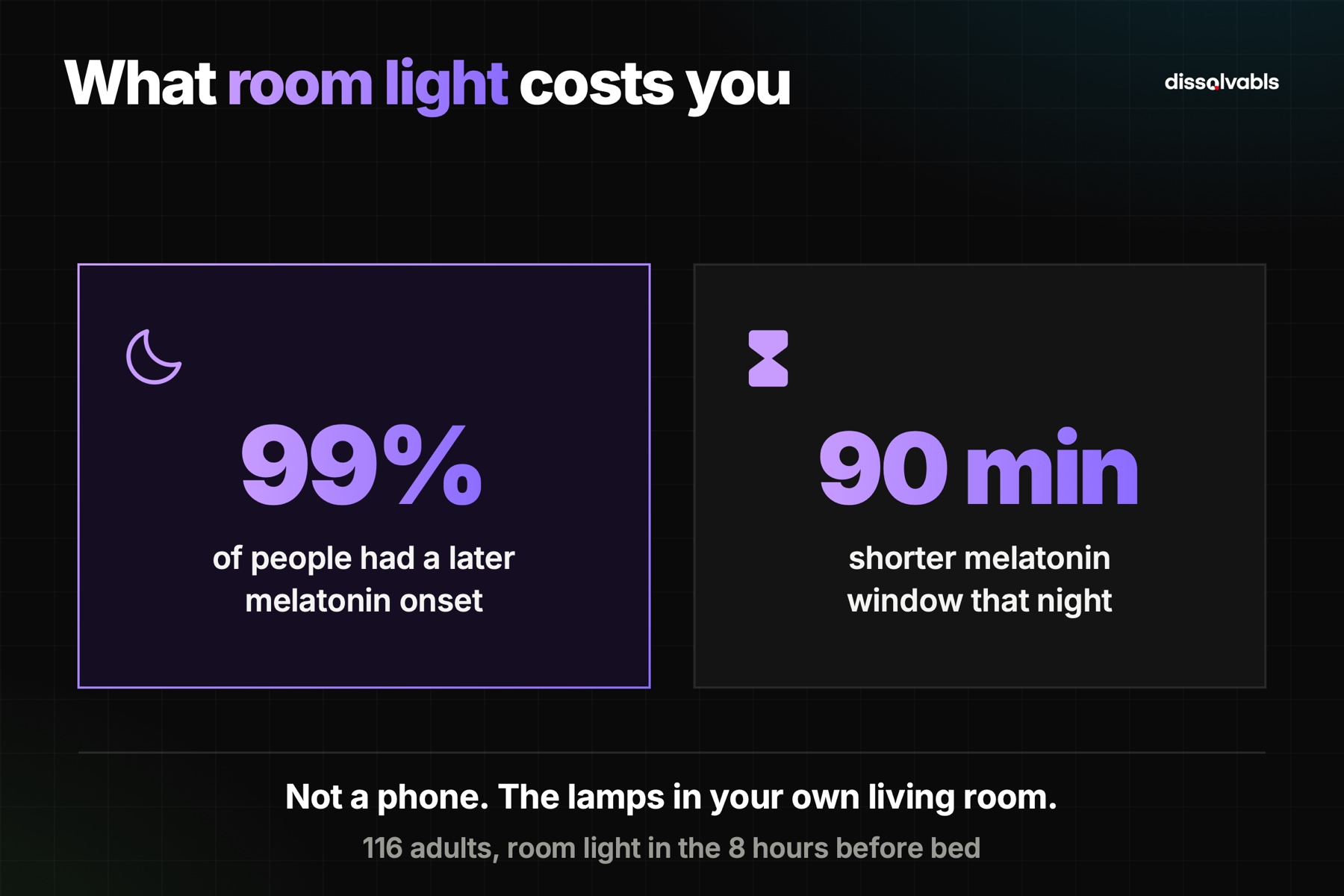
- Ordinary room light moves that window later. In a study of 116 adults, room light in the hours before bed delayed melatonin onset in 99% of people and cut the melatonin window by about 90 minutes.
- The 3 p.m. coffee is tonight's problem. Caffeine clearance varies widely between people because of age, tolerance, genetics and even some medications, so the cutoff hour a coworker swears by can be useless for you.
- The goal is a shutdown, not a knockout. Sedating yourself harder does not fix a timing problem, and it is what produces the groggy morning you were trying to avoid.
What Tired but Wired Actually Is
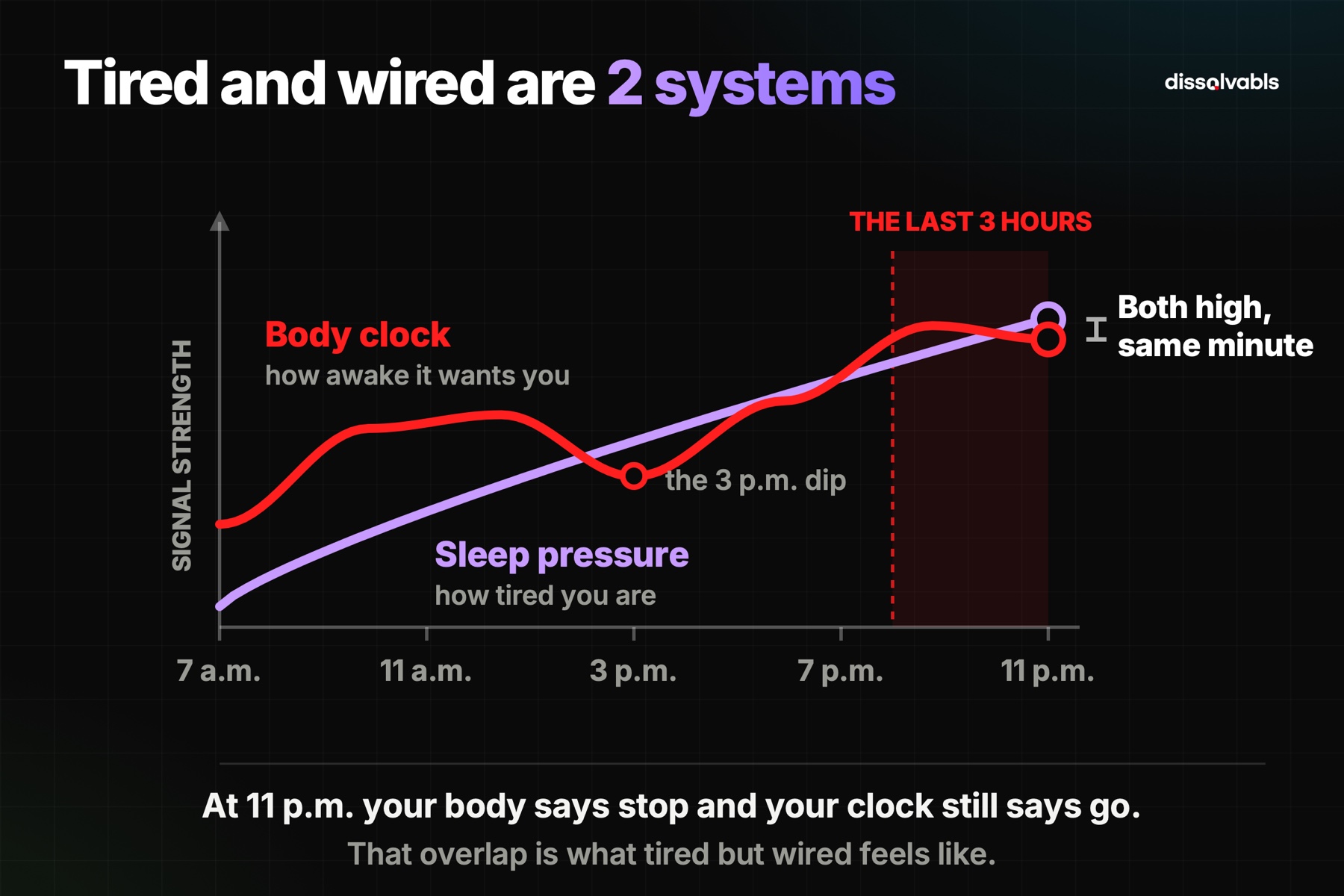
Sleep runs on 2 processes at once. The first is sleep pressure: from the moment you wake up, it builds, and the longer you are awake the heavier it gets. That is the tired part, and by 10 p.m. after a real day it is enormous.
The second is your circadian clock. It does not care how long you have been awake. It runs a roughly 24 hour program that pushes alertness up and down on its own schedule, and researchers describe sleep as the result of those 2 processes interacting rather than either one alone.
Tired but wired is what happens when they disagree. Sleep pressure is screaming and the clock is still holding the alertness signal up. Your body is ready. The switch has not flipped.
The 3 Hours Your Body Fights Sleep on Purpose
This is the part almost nobody knows, and it reframes the whole problem.
There is a window in the evening where your circadian system pushes alertness to its daily peak, right before it hands over to melatonin. Sleep scientists call it the wake maintenance zone, and in the research it is defined as the 3 hours before your own melatonin onset. In a study of 23 adults kept awake for 40 hours straight, that window still improved sustained attention and self-rated concentration compared with the hours just before it. People who had been awake for a day and a half were measurably sharper inside it.
Read that again, because it explains your Tuesday. Your body is not broken when you lie down exhausted and feel your brain switch on. You are lying down inside the window your clock is built to defend. Push your bedtime into it, and you are asking to fall asleep at the exact hour your body is least willing to.
That is also why the fix is not more effort. You cannot out-willpower the wake maintenance zone. What you can do is stop making it later than it already is, which is where the next part comes in.
The 4 Habits That Keep the Switch Stuck
1. Light, and specifically the light in your own house
Most advice here is about phones, which undersells the problem. In a study at a clinical research center, 116 healthy adults spent their evenings under either dim light or ordinary room light. Room light in the 8 hours before bed suppressed melatonin, pushed melatonin onset later in 99% of participants, and shortened the nightly melatonin window by about 90 minutes.
Not a stadium. Not a screen held to your face. The lamp in your living room. If you are wired at 11 p.m., the kitchen you stood in at 9 p.m. is part of the reason.
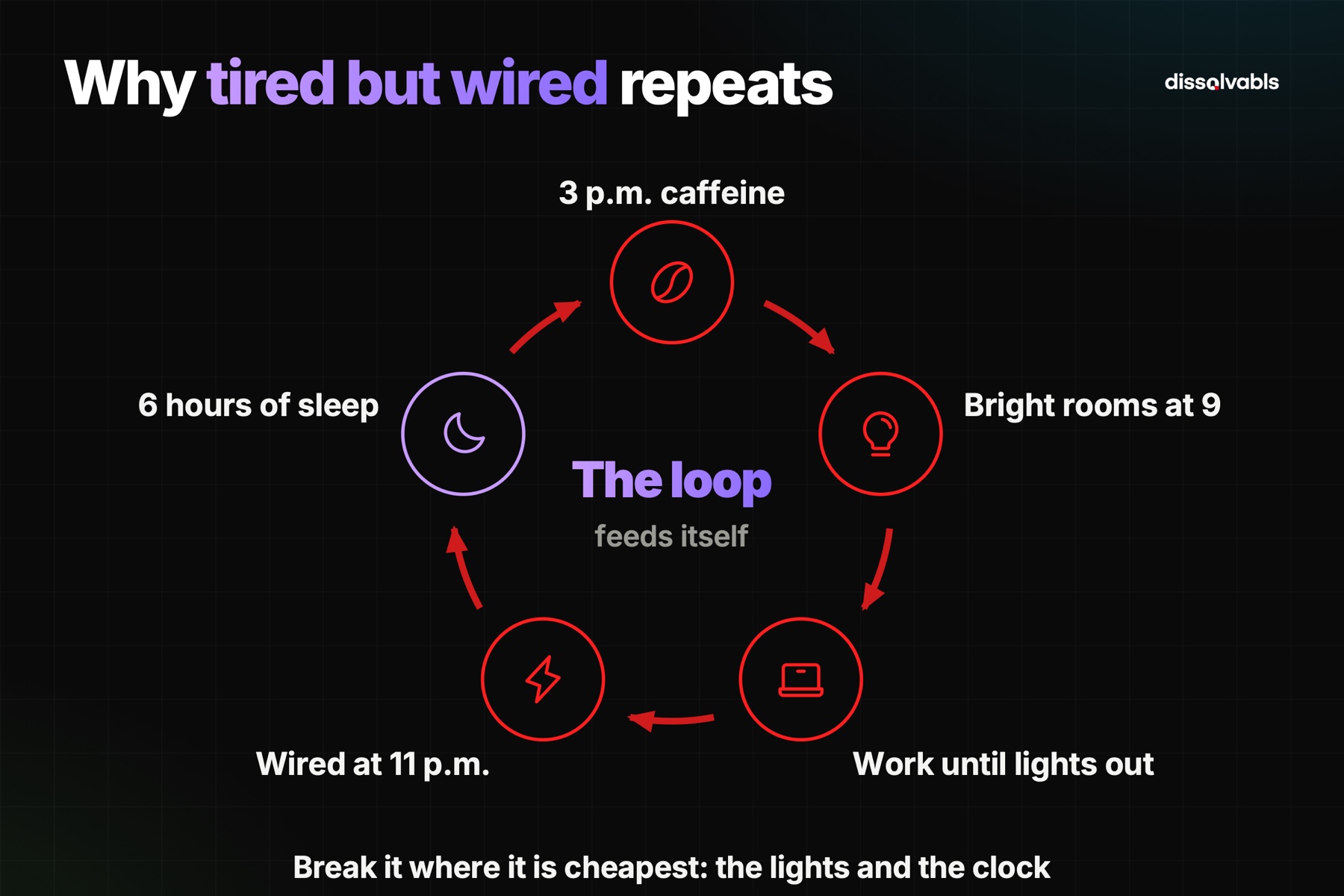
The fix: cut the overhead lights an hour before bed and work off 1 or 2 low lamps. It costs nothing and it is the single highest-leverage change on this list.
"Lights down" is vaguer than it sounds, so here is the version you can actually run. Kill the overhead fixtures, which are the bright ones, and leave 1 or 2 lamps at or below eye level. Warm bulbs over cool ones. Phone and laptop on their dimmest setting, and moved off your face rather than held to it.
Then fix the room everyone forgets: the bathroom. It is usually the brightest room in the house and it is the last one you walk into before bed, at exactly the moment your melatonin should be climbing. A 4 minute blast of bathroom light can undo the hour you just spent in a dim living room. Swap the overhead for a lamp, a nightlight or the mirror light alone, and keep the tired but wired window from resetting at the last second.
2. Caffeine you stopped counting
The coffee at 3 p.m. is not about 3 p.m. A 2026 review of caffeine and sleep research points out that clearance varies widely between individuals, driven by age, tolerance, genetics and even medications such as oral contraceptives, which means the cutoff time your coworker swears by can be useless for you.
The practical version: count everything, not just the cup you remember. Coffee, tea, soda, pre-workout, the energy drink at 4 p.m. The FDA's general guideline for healthy adults is up to 400 mg a day, about 2 to 3 cups of coffee, and where those milligrams land in the day matters as much as the total.
The fix: move your last real dose earlier and make it measurable. This is the argument for a dose you can count instead of a cup you cannot: mint-flavored Energy Que-Strips™ carry 50 mg of caffeine, about half a cup of coffee, with 30 mg of L-theanine and 20 mg of ginseng. Our breakdown of the 3 p.m. crash covers why that dip shows up in the first place.
3. A day that ends at the pillow
If the last thing you do before bed is work, your nervous system gets no signal that the day is over. You close the laptop and lie down still running at the speed the day demanded. The body follows the last instruction it was given, and yours was "go."
The fix: put a buffer between the work and the bed. It does not have to be long. It has to be consistent, and it has to be the same every night, which is the whole point of the next section.
4. A bedtime that moves every night
Your clock anchors to patterns. Bed at 10 on Monday, 1 a.m. on Tuesday, 11:30 on Wednesday, and it never settles on when to start the handoff. Wake maintenance zone, melatonin onset, the whole sequence floats with it. This is the hardest one for shift workers, founders and anyone whose week is decided by other people, and it is also the one with the biggest payoff.
The fix: pick the hour you can hit most nights, not the ideal one. Consistency beats the perfect bedtime you will miss 4 nights out of 7.
How to Shut Your Brain Off Without Knocking Yourself Out
The instinct when you are tired but wired is to hit the problem harder: a stronger sleep aid, a drink, whatever makes the lights go out. That is treating a timing problem like a force problem, and it is exactly how people end up groggy the next morning.
A shutdown works differently. You are not trying to be unconscious in 5 minutes. You are giving your body the same sequence of cues at the same hour until it starts the handoff on its own.
- Same 30 minutes, same order, most nights. Lights down, screens away, the same small steps in the same sequence. The order matters more than the contents.
- Write the loop down and close it. If your brain is running the invoice, the invoice goes on paper and the meeting is over. This is the cheapest way to stop overthinking at night.
- Stop trying to fall asleep. Effort is arousal. If you are awake after a while, get up, keep the lights low, and go back when you feel heavy.
- Give it more than one night. A clock that drifted for months does not reset on a Tuesday.
This is the logic Dissolvabls built the Sleep Que-Strips™ around: a shutdown, not sedation. One lavender-flavored strip under the tongue about 30 minutes before bed, dissolved in 10 to 15 seconds with no water, carrying melatonin as the timing signal with valerian, L-theanine, chamomile, ashwagandha and vitamin B6 in supporting amounts rather than one large dose of anything. The routine is the point, and the strip is a cue inside it. We laid out the full sequence in our guide to the 30-minute wind-down.
As with any supplement, check with your doctor if you have a health condition, take medication or are pregnant.
What This Looks Like If You Actually Work for a Living
The advice changes shape depending on whose day it is. Three versions, because the fix has to survive the job.
The 12-hour shift. A nurse coming off nights gets home when the sun is up and the clock is screaming "day." Here light is the whole battle, in both directions: dark on the way home and at home, bright at the start of the shift. The bedtime will never be conventional, so the anchor is the sequence, not the hour on the clock.
The founder with a 7 a.m. call. The day ends when the laptop closes, usually in bed, usually after a last round of email. This is the buffer problem in its purest form. The move is not sleeping earlier, which will not happen. It is putting 30 minutes of something else between the last decision of the day and the pillow, every night, so the body gets a signal that the shift is over.
The trade that starts at 6 a.m. Physically wrecked, mentally still going, and an alarm that does not negotiate. The temptation is the drink that makes the lights go out. That is sedation, and it buys tonight by charging tomorrow morning. A steady wind-down plus an earlier caffeine cutoff does more for the 6 a.m. than anything you can take at 11 p.m.
The common thread is that none of these people need more discipline. They need the inputs that push the switch later to stop pushing, and they need the same small sequence every night so the clock has something to anchor to.
When Tired but Wired Is Not Just a Bad Week
Everything above assumes a normal, overloaded life: too much to do, a schedule that moves, lights on until midnight. That describes most people who search for this.
It does not describe everyone. If you are wired at night for weeks at a time, if you wake at 3 a.m. and stay up, if you are exhausted all day no matter how long you were in bed, or if your heart races when you lie down, that is a conversation for a doctor, not an article. Sleep problems that stick around can point to something a routine will not fix, and the useful move is getting it looked at rather than stacking supplements on top of it.
Frequently Asked Questions
What does tired but wired mean?
It describes being physically exhausted while mentally alert, usually at night. In sleep terms, your sleep pressure is high after a long day but your body clock is still sending an alertness signal, so the handoff into sleep does not happen when you lie down.
What causes tired but wired?
A timing mismatch, usually pushed by 4 everyday things: bright indoor light late in the evening, caffeine later than your body clears it, working right up to bedtime, and a bedtime that moves around. Each one delays the moment your body is ready to start the handoff.
Is tired but wired caused by cortisol?
Cortisol is part of the picture, not the whole of it. Cortisol follows its own daily curve and stress keeps it elevated when it should be low, which adds to evening arousal. But the core of tired but wired is the interaction between sleep pressure and the circadian clock, and that is where the fixes live.
How do you fix tired but wired?
Stop pushing your melatonin onset later. Cut the overhead lights an hour before bed, move your last caffeine earlier, put a buffer between work and the pillow, and keep your bedtime steady enough that your clock can anchor to it. Then give it more than one night.
Why do I get a second wind at night?
You are most likely running into the wake maintenance zone, the roughly 3 hour window before melatonin onset when your clock pushes alertness to its daily peak. In one study, people awake for 40 hours were still sharper inside that window than in the hours right before it.
Does melatonin help when you are tired but wired?
Melatonin is a timing signal, not a sedative, so what matters most is when you take it relative to your own schedule. We do not give dosing advice. Read the label, look for ingredients listed with their own milligram amounts rather than hidden in a blend, and check with your doctor.
How long does it take to fix being wired and tired?
Expect nights, not one night. You are moving a clock, and the changes that move it fastest are light and consistency. Judge it after a week of doing the same thing at the same hour, not after one attempt.
The Short Version
Tired but wired is not you failing to relax. It is a body at the end of its day and a clock that has not handed over yet, made worse by the lamp in the hallway, the coffee you forgot about and a bedtime that moves. Fix the inputs, keep the hour steady, and run the same shutdown every night. The switch flips a lot easier when you stop asking it to flip at the worst hour of the day.
Sources
- Gooley JJ, Chamberlain K, Smith KA, et al. Exposure to room light before bedtime suppresses melatonin onset and shortens melatonin duration in humans. The Journal of Clinical Endocrinology and Metabolism, 2011.
https://pmc.ncbi.nlm.nih.gov/articles/PMC3047226/ - Shekari Soleimanloo S, Wilkinson VE, Cori JM, et al. The impact of the wake maintenance zone on attentional capacity, physiological drowsiness, and subjective task demands during sleep deprivation. Journal of Sleep Research, 2021.
https://pubmed.ncbi.nlm.nih.gov/33734527/ - Treatise on an alternative perspective on the two-process model of sleep regulation. npj Biological Timing and Sleep, 2025.
https://pmc.ncbi.nlm.nih.gov/articles/PMC12912424/ - The Caffeinated Brain Part 2: The Effect of Caffeine on Sleep-Related Electroencephalography. Nutrients, 2026.
https://pmc.ncbi.nlm.nih.gov/articles/PMC13119445/ - U.S. Food and Drug Administration. Spilling the Beans: How Much Caffeine is Too Much?
https://www.fda.gov/consumers/consumer-updates/spilling-beans-how-much-caffeine-too-much - Centers for Disease Control and Prevention. Sleep Difficulties in Adults, NCHS Data Brief 559, 2026.
https://www.cdc.gov/nchs/products/databriefs/db559.htm