The 3 PM Crash Could Be Costing America $700 Billion a Year
The 3 PM afternoon energy crash affects 71% of workers and costs America $700 billion annually. Learn the science behind it and how to beat it.
It hits right on schedule. The inbox blur at 2:55 PM. The same paragraph read three times. The sudden urge to stare at the ceiling. If that sounds familiar, you are far from alone, and the cost of that afternoon energy crash, scaled across the entire American workforce, is almost too big to print.
The number we keep coming back to: $700 billion a year. That is our midpoint estimate for what the daily afternoon slump costs U.S. employers in lost output. Below, we'll show you exactly how we built that figure, and, more importantly, what you can actually do about yours.
Key Takeaways
The slump is biological, not personal: Drowsiness in the late afternoon is part of the body's normal circadian rhythm, which dips significantly between 2 and 5 PM, according to the National Sleep Foundation. Even people who slept eight hours hit it.
Most workers are affected: A majority (71%) of desk workers agree that the late afternoon is the worst time for work, with productivity plummeting between the hours of 3 and 6 PM, based on a global Slack survey of over 10,000 desk workers. If your team looks half-asleep by mid-afternoon, check your meeting and task structure before blaming commitment.
The cost is invisible but massive: For U.S. employers, fatigue carries overall estimated costs of more than $136 billion per year in health-related lost productivity, and 84% of those costs come from reduced performance while at work, rather than absences. The worker showing up foggy costs more than the worker who stays home.
Sleep debt makes everything worse: The 3 PM energy crash is primarily a circadian rhythm phenomenon, but sleep debt significantly amplifies the dip, turning a mild alertness drop into a full cognitive shutdown. Fix the night before you fix the afternoon.
Small, layered changes work: The most effective approach layers several small changes: a balanced, moderate lunch, a short walk afterward, steady hydration through the morning, well-timed caffeine, and good sleep the night before. No single fix eliminates it, but stacking habits cuts it down fast.
Quick-Start Prioritization Framework
| Strategy | Best For | Effort Level | Time to Results |
|---|---|---|---|
| 10-min post-lunch walk | Everyone | Low | Same day |
| Swap refined-carb lunch for protein and fiber | Everyone | Low-Med | 3-5 days |
| Delay first caffeine to 90 min after waking | Caffeine-heavy doers | Low | 3-7 days |
| Structured afternoon break (calendar block) | Office and remote workers | Low | Same day |
| Consistent sleep/wake time | Chronically tired workers | Med | 1-2 weeks |
| Targeted low-dose afternoon caffeine (timed) | Deadline-heavy afternoons | Low | Same day |
Start here if you are:
Usually fine but crashing today: Take a 10-min walk right now, drink 12 oz of water, and eat a small protein snack. This is your fastest stabilization move.
Crashing every single day: Focus on lunch composition and sleep consistency first. Those two levers move more than any supplement or energy product.
Crashing and facing a late meeting or deliverable: A small, controlled dose of caffeine timed 60 to 90 minutes before the commitment is the most practical short-term option. Keep the dose sensible, more caffeine is not always more energy.
How Big Is the 3 PM Problem, Really?
Let's build the number from the ground up, because the headline figure deserves a foundation.
How We Calculated This
Here is the math, using only confirmed public data:
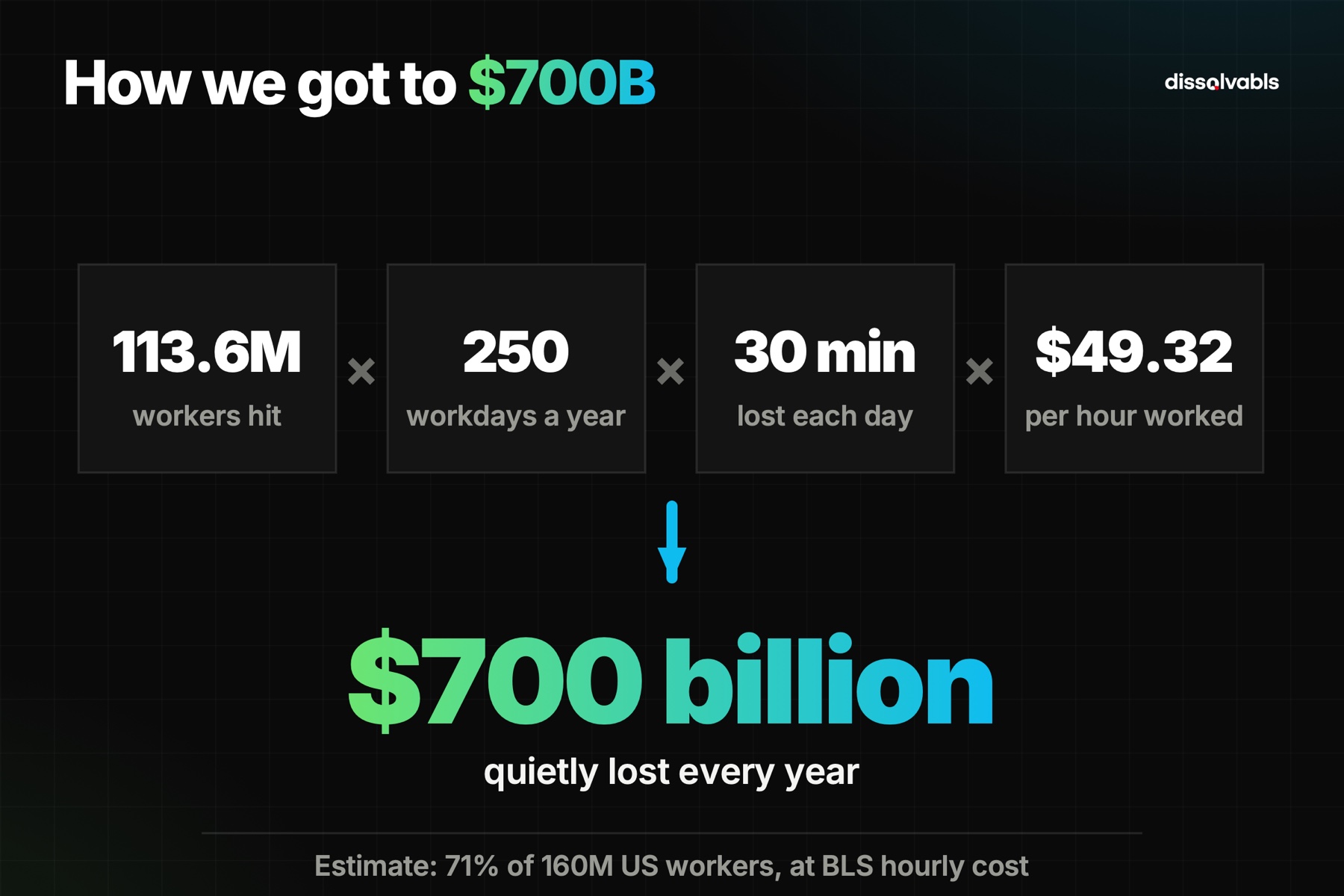
Workers: Total nonfarm payroll employment in the United States sits at approximately 159 million as of March 2026, based on Bureau of Labor Statistics data. We use 160 million as a round working figure.
Affected workers: A majority (71%) of desk workers agree that the late afternoon is the worst time for work, with productivity plummeting between the hours of 3 and 6 PM, per Slack's global survey. Applying 71% to 160M gives approximately 113.6 million affected workers.
Workdays per year: 250 (standard five-day year, excluding federal holidays).
Hourly employer cost: Employer costs for employee compensation for civilian workers averaged $49.32 per hour worked in March 2026, according to the U.S. Bureau of Labor Statistics.
Time lost per day: This is the honest variable. The average afternoon slump lasts almost 30 minutes, per OnePoll research. We model three scenarios:
| Time Lost Daily | Estimated Annual Cost |
|---|---|
| 15 minutes | ~$350 billion |
| 30 minutes | ~$700 billion |
| 60 minutes | ~$1.4 trillion |
The 30-minute scenario produces the headline: 113.6M workers x 250 days x 0.5 hours x $49.32/hr = approximately $700 billion.
Disclosure and guardrails: The 71% figure comes from Slack's global survey of desk workers and is not a randomized controlled trial. The calculation applies only to desk-adjacent workers who experience afternoon productivity loss; it does not represent every worker in every industry. The figures in this box ($700B) and the Ricci et al. $136B, RAND's $411B, and NSC totals overlap significantly and must not be added together; they measure related but distinct aspects of workforce fatigue and lost productivity.
Why Your Body Does This (and Why Willpower Cannot Stop It)
Understanding the science matters because it reframes the afternoon as a system problem, not a character flaw.
The Circadian Dip Is Real, Documented, and Universal
The 3 PM slump is linked to the circadian rhythm, a natural, internal process that regulates the sleep-wake cycle and energy levels over a 24-hour period. A decrease in alertness typically occurs between 2 PM and 4 PM, even if a person has had a good night's sleep.
The NHTSA tracks this same dip in its drowsy driving data: drowsy driving crashes occur most frequently between midnight and 6 AM, or in the late afternoon, because at both times of the day people experience dips in their circadian rhythm, the human body's internal clock that regulates sleep. When the science is serious enough to show up in crash data, it is serious enough to affect your spreadsheet.
Pro Tip: Stop scheduling your most cognitively demanding work, client proposals, strategic decisions, complex writing, in the 2:30 to 4 PM window. Move administrative tasks, routine email, and relationship check-ins there instead. You are working with your biology, not surrendering to it.
Sleep Debt Turns a Dip Into a Dive
A well-rested person feels the circadian dip as a gentle softening of focus. A sleep-deprived person feels a wall. A lack of sleep among the U.S. working population is costing the economy up to $411 billion a year, which is 2.28 percent of the country's GDP, according to a landmark RAND Corporation analysis. That figure covers economy-wide sleep deprivation effects from absenteeism, presenteeism, and higher mortality risk, context for the scale of the problem, though it covers a broader category than afternoon productivity loss alone.
Workers who sleep fewer than six hours per night cost employers about six workdays a year in productivity, while employees who sleep six to seven hours each night cost employers 3.7 workdays a year in productivity, according to the National Safety Council. The math is simple: better sleep tonight creates a better afternoon tomorrow.
What the Research Says About the Actual Cost to Employers
The macro number is striking, but the per-employee cost is where it becomes personal for anyone running a team.
The Ricci Findings: Presenteeism Dominates
The 2-week period prevalence of fatigue was 37.9% in a national survey of U.S. workers. Of workers with fatigue, 65.7% reported health-related lost productive time, compared with 26.4% of those without fatigue. Workers with fatigue cost employers $136.4 billion annually in health-related lost productive time. This 2007 study by Ricci et al. in the Journal of Occupational and Environmental Medicine remains one of the most cited benchmarks in workforce fatigue research.
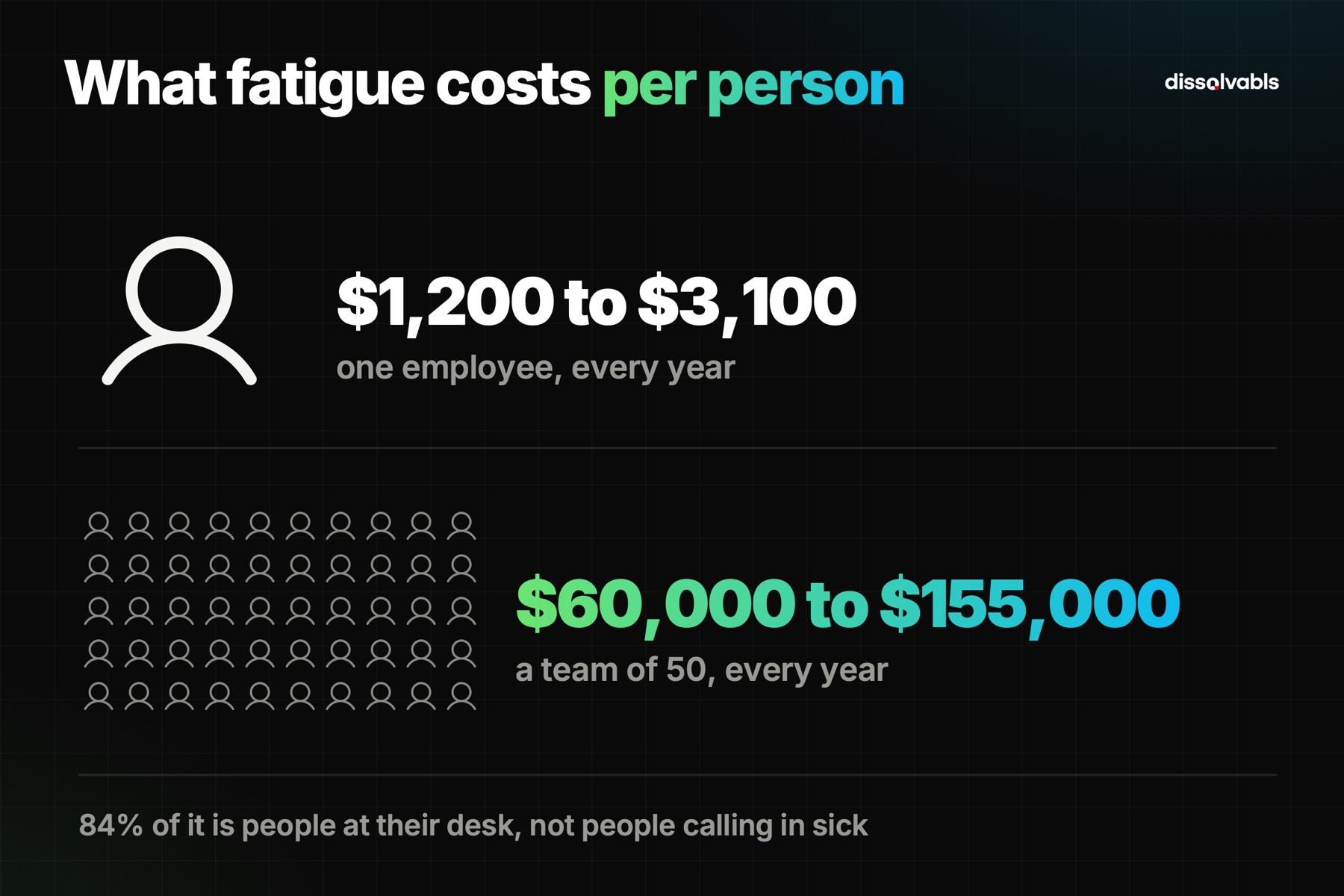
The important detail: eighty-four percent of the costs were related to reduced performance while at work, rather than absences. The person sitting at their desk half-checked-out generates far more cost than the person who calls in sick.
The Per-Employee Number
According to the National Safety Council, fatigued workers cost employers $1,200 to $3,100 per employee annually in productivity losses alone. For a team of 50 people, that range spans $60,000 to $155,000 per year, real money before you count errors, decision quality, or client-facing moments where someone was visibly off.
If your team averages 40 people, a conservative estimate puts $48,000 to $124,000 of annual value at risk from chronic fatigue alone. That is enough to hire a part-time employee, fund a wellness program, or both.
Pro Tip: If you manage a team, consider blocking the 2:45 to 3:15 PM window on the shared calendar once a week as a no-meeting buffer. Research on break-taking from Slack's Workforce Lab found that even a 5-minute break improves afternoon productivity meaningfully.
The Five Levers That Actually Work
This is the section most readers came for. Here are the interventions with the strongest practical track record for flattening the afternoon energy crash.
Lever 1: Rethink Lunch Composition
Most people have a mild decline in alertness after midday, even after a good night of sleep. A large or fast-digesting lunch can amplify it, especially when built around refined carbohydrates such as white bread, chips, pastries, or sweet drinks. Those foods can raise blood sugar quickly, and the body's insulin response creates a drop in circulating blood sugar that leaves you tired and searching for another snack.
The fix is not to eat less; it is to eat differently. Prioritize protein and fiber at lunch. Think grilled chicken over white pasta, a grain bowl over a sub roll, Greek yogurt over a cookie. Research from the Health Enhancement Research Organization shows that employees who regularly eat healthy meals achieve up to 25% higher productivity at work compared to those who do not eat healthily. Swap one carb-heavy lunch per week to start; you will feel the difference the same afternoon.
Lever 2: Move After You Eat
Ten minutes of brisk walking after lunch, a few flights of stairs, light mobility work, or a brief walk outside can improve alertness without leaving you sweaty at your desk. Movement increases circulation and bumps dopamine and norepinephrine, exactly what the circadian dip suppresses. This is the highest-ROI move on the list and costs nothing.
Natural sunlight is especially helpful since getting outside, even briefly, may help suppress the melatonin your body produces during that afternoon window. Even a five-minute walk to the end of the block and back resets the clock meaningfully.
Lever 3: Time Your Caffeine Strategically
Most doers get this backwards. They load caffeine in the morning, coast through the peak alertness window, and reach for another cup right as the crash hits at 3 PM. The problem: caffeine has a half-life of about 5 to 6 hours, meaning half of what you drink at 3 PM is still in your system at 9 PM. That late cup may help short-term, but it can wreck your sleep and set you up for an even worse crash tomorrow.
The smarter play is to use a smaller, better-timed dose before the dip rather than during it. If you typically crash at 3 PM, a modest caffeine hit at 1:30 to 2 PM builds the bridge. Dissolvabls makes this precise with their Que-Strip Energy formula, a thin dissolvable film that absorbs under the tongue in 10 to 15 seconds and delivers 50 mg of natural caffeine from green coffee. That is roughly half a cup of coffee: enough to carry the next 90 minutes, not enough to hijack tonight's sleep. It is a finish-line product for the 3 PM to 5 PM stretch or the hour before a late meeting, not a replacement for a real morning coffee routine, and that is the point. Dose control matters. Dissolvabls backs the formula with a 30-day money-back guarantee if it does not work for your routine.
Lever 4: Hydrate Before You Are Thirsty
Dehydration of just 1 to 2% can impair cognitive performance and short-term memory, according to the Journal of the American College of Nutrition. By mid-afternoon, especially after a morning of coffee, most people are mildly dehydrated. The fog they attribute to hunger or boredom is partly just thirst.
Keep a full water bottle visible on your desk. Drink 8 to 12 oz before lunch and before your afternoon break. If your afternoon crash comes with a headache, dry mouth, or brain fog, hydration may be part of the problem.
Lever 5: Protect the Night Before
Every strategy above becomes more effective when you show up to 3 PM with decent sleep behind you. More than 43% of workers are sleep-deprived, and those most at risk work the night shift, long shifts, or irregular shifts. A consistent wake time is the single most powerful dial in sleep quality, even more than bedtime. Pick a wake time and hold it within 30 minutes, seven days a week, for two weeks. The afternoon dip will soften noticeably.
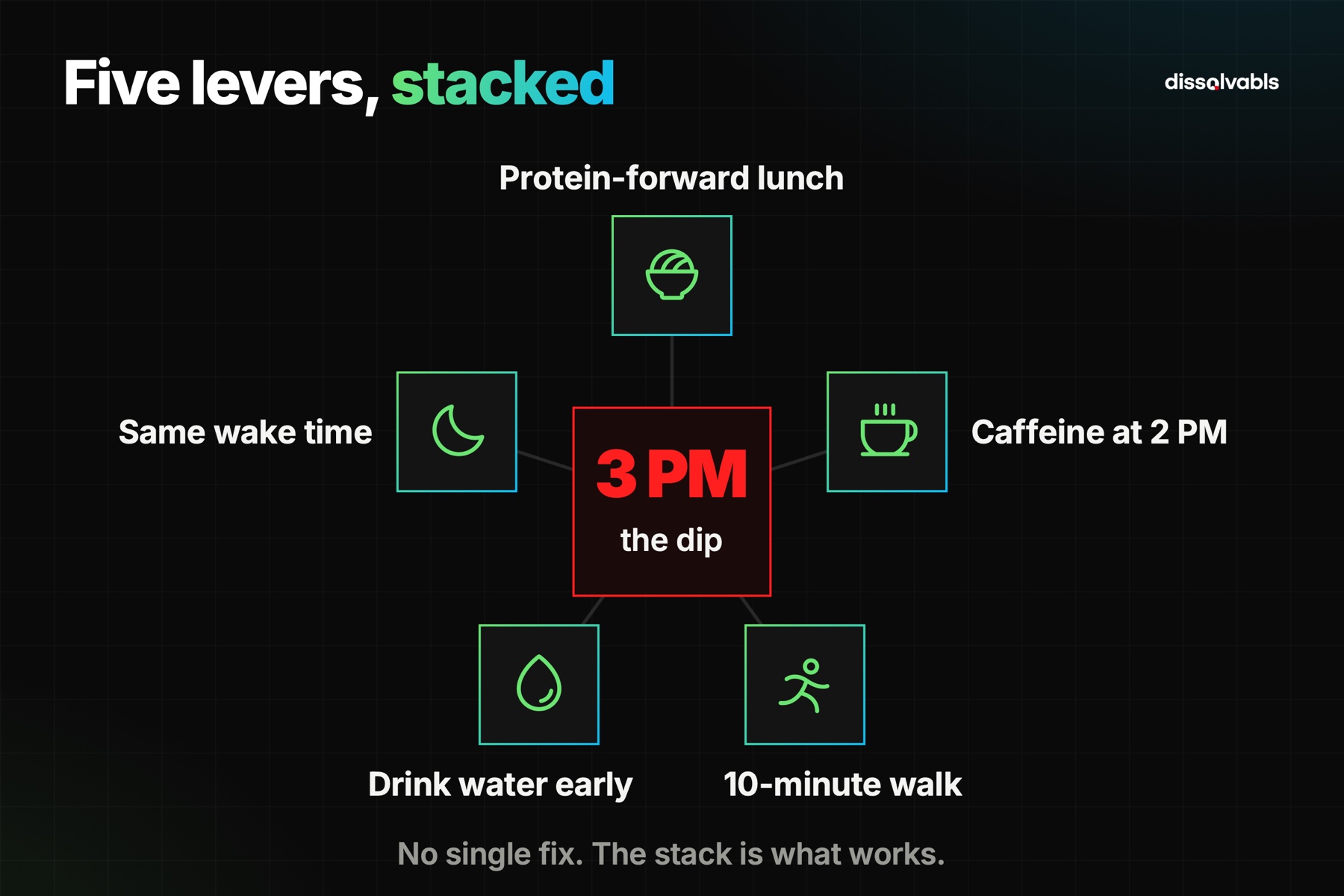
Pro Tip: Build your afternoon reset into a 3-step routine you can do anywhere. Step one: drink a full glass of water. Step two: walk for at least five minutes (outside if possible). Step three: if you have a late meeting or deadline, use a calibrated small caffeine dose at this point, not after the crash has already landed. Prevention beats recovery every time.
Common Mistakes That Make the Afternoon Crash Worse
Knowing what to avoid is as useful as knowing what to do.
Reaching for Sugar
The vending machine run feels logical, your brain is low on energy, sugar is fast energy. The problem is the spike and crash that follows within 30 to 45 minutes. Meals that are high in quickly digested carbohydrates or spaced too far apart can lead to fluctuations in blood sugar, which may contribute to feeling tired, less focused, and craving something sweet. The sugar fix extends the cycle rather than ending it.
Drinking a Large Coffee at 3 PM
This one is worth repeating because it is so common. A big late-day espresso may get you through a 4 PM call, but it raises the floor of your next-night sleep, which makes tomorrow's slump worse. Use a smaller, better-timed dose instead.
Scheduling High-Stakes Work During the Dip
Research has found that doctors are more likely to prescribe unnecessary antibiotics and less likely to order important follow-up tests in afternoon appointments compared with morning ones. If that gap exists in clinical medicine, it exists in your industry too. Move your highest-stakes decisions earlier in the day wherever schedule flexibility allows.
Frequently Asked Questions
Is the 3 PM energy crash actually normal, or does it mean something is wrong?
The afternoon energy crash between 1 and 4 PM is a documented feature of human circadian biology and appears even in well-rested people in controlled sleep lab conditions. A short afternoon energy dip between 1 and 3 PM is a normal part of your body's circadian rhythm, especially if it lifts quickly with movement, hydration, or a brief break. However, persistent or overwhelming afternoon fatigue may signal an underlying health issue worth investigating. If yours does not lift at all with basic interventions, speak to a doctor.
How much does the afternoon crash actually cost my employer?
According to the National Safety Council, fatigued workers cost employers $1,200 to $3,100 per employee annually in productivity losses alone. Multiply that by your team size to get a rough floor estimate. The calculation in this article suggests a 30-minute daily slump across the broader affected workforce adds up to approximately $700 billion nationally.
Can caffeine fix my afternoon energy crash?
Caffeine can smooth the dip if timed correctly, roughly 60 to 90 minutes before the crash, not during it. A smaller dose (around 50 mg) timed for 1:30 to 2 PM works better than a large dose at 3 PM. Caffeine has a half-life of about 5 to 6 hours, meaning half of what you drink at 3 PM is still in your system at 9 PM, so late-day overdosing creates a cycle that worsens tomorrow's crash. Timing and dose control matter more than the total amount.
Why does a heavy lunch make the afternoon worse?
A carbohydrate-heavy lunch triggers a rapid rise and fall in blood sugar. Food is one of the strongest signals affecting afternoon energy. Fast-digesting carbohydrates, like white bread, sugary drinks, and refined snacks, can create rapid spikes in blood sugar followed by sharp drops. The circadian dip stacks on top of that glucose crash, doubling the effect. A protein-forward, moderate-carb lunch removes one of the two drivers.
What is the fastest thing I can do right now if I am already crashing?
The fastest three-step reset: drink 12 oz of water, walk briskly for 5 to 10 minutes (outside if possible, for the sunlight), and eat a small protein snack if you have not eaten in more than three hours. Light movement is one of the fastest ways to reset your energy. Even walking around the building or stepping outside for fresh air can help. Natural light helps regulate your circadian rhythm and supports healthy energy patterns. If you have a deadline in the next 90 minutes, a controlled, small caffeine dose at this point is a reasonable addition.
Conclusion
The afternoon energy crash is one of those costs that never appears as a line item, no invoice, no alert, no budget variance report. Productivity stalls, and while it may seem harmless, that daily lull adds up to lost momentum, missed opportunities, and frustrated employees. At scale, our back-of-envelope estimate using Employer costs for employee and Slack's 71% prevalence figure puts the 30-minute scenario at approximately $700 billion per year in economic output quietly lost every weekday between 3 and 5 PM.
The good news is that the dip is predictable, which means it is manageable. Fix your lunch. Move your body. Time your caffeine with intention. Protect your sleep. That four-part sequence, repeated consistently, will flatten the crash more than any single product or hack. Doers do not accept the slump as a fact of life; they engineer around it.
Sources
Slack Workforce Lab, After-Hours Work and Productivity Survey, Slack. Global survey of 10,000+ desk workers finding 71% experience worst productivity between 3-6 PM. https://slack.com/blog/news/the-surprising-connection-between-after-hours-work-and-decreased-productivity
Fatigue in the U.S. Workforce: Prevalence and Implications for Lost Productive Work Time (Ricci et al., 2007), PubMed / Journal of Occupational and Environmental Medicine. https://www.cdc.gov/niosh/bulletin/2023/fatigue.html
Employer Costs for Employee Compensation, March 2026, U.S. Bureau of Labor Statistics. Civilian workers average $49.32/hr total compensation. https://www.bls.gov/opub/ted/2026/compensation-costs-for-civilian-workers-averaged-49-32-per-hour-worked-in-march-2026.htm
Why Sleep Matters: Quantifying the Economic Costs of Insufficient Sleep, RAND Corporation. U.S. loses up to $411 billion/year to sleep deprivation. https://www.rand.org/randeurope/research/projects/2016/the-value-of-the-sleep-economy.html
Drowsy Driving, NHTSA. Documents late-afternoon circadian dip as crash risk factor. https://www.iii.org/fact-statistic/facts-statistics-drowsy-driving
Sleep Drive and Your Body Clock, National Sleep Foundation. Explains afternoon circadian dip in alertness. https://www.sleepfoundation.org/circadian-rhythm/sleep-drive-and-your-body-clock
The Worst Time of Day to Be Productive, CNBC, citing Slack research and National Sleep Foundation. https://www.cnbc.com/2023/12/14/the-worst-time-of-day-to-be-productive-according-to-new-slack-research.html
Your Guide to Avoiding the 3PM Slump at Work, University of Queensland. Circadian rhythm and afternoon alertness. https://stories.uq.edu.au/contact-magazine/your-guide-to-avoiding-the-3pm-slump-at-work/index.html
Employment in the United States Statistics 2026, MakerStations. Total nonfarm payroll employment ~159 million, March 2026. https://fred.stlouisfed.org/series/PAYEMS
How Worker Fatigue Harms the Bottom Line, EHS Today / JOEM. Presenteeism accounts for 84% of fatigue costs. https://www.ehstoday.com/training-and-engagement/article/21265555/how-worker-fatigue-harms-the-bottom-line
Afternoon Energy Crash: What Actually Works, Biology Insights. Layered intervention approach. https://biologyinsights.com/how-to-avoid-the-afternoon-crash-what-actually-works/
What Causes the Afternoon Energy Crash, Graymatter Labs. Caffeine half-life and timing strategy. https://trygraymatter.com/blogs/science/afternoon-energy-crash