Sugar Free Energy Strips: What to Look For and What to Skip
Learn what to look for in sugar free energy strips. Find out which ingredients matter, what to avoid, and how to read labels in 60 seconds.
You already know the format. A thin film, tongue, done. No can, no pill, no mess. The real question is what's actually inside the strip you're peeling open, and whether the label holds up when you look closely. The market has grown fast and the quality gap between products is wide.
This guide is written for doers who've already decided strips are the right format. The goal is to help you read a label in 60 seconds and know whether to buy or put it back.
Key Takeaways
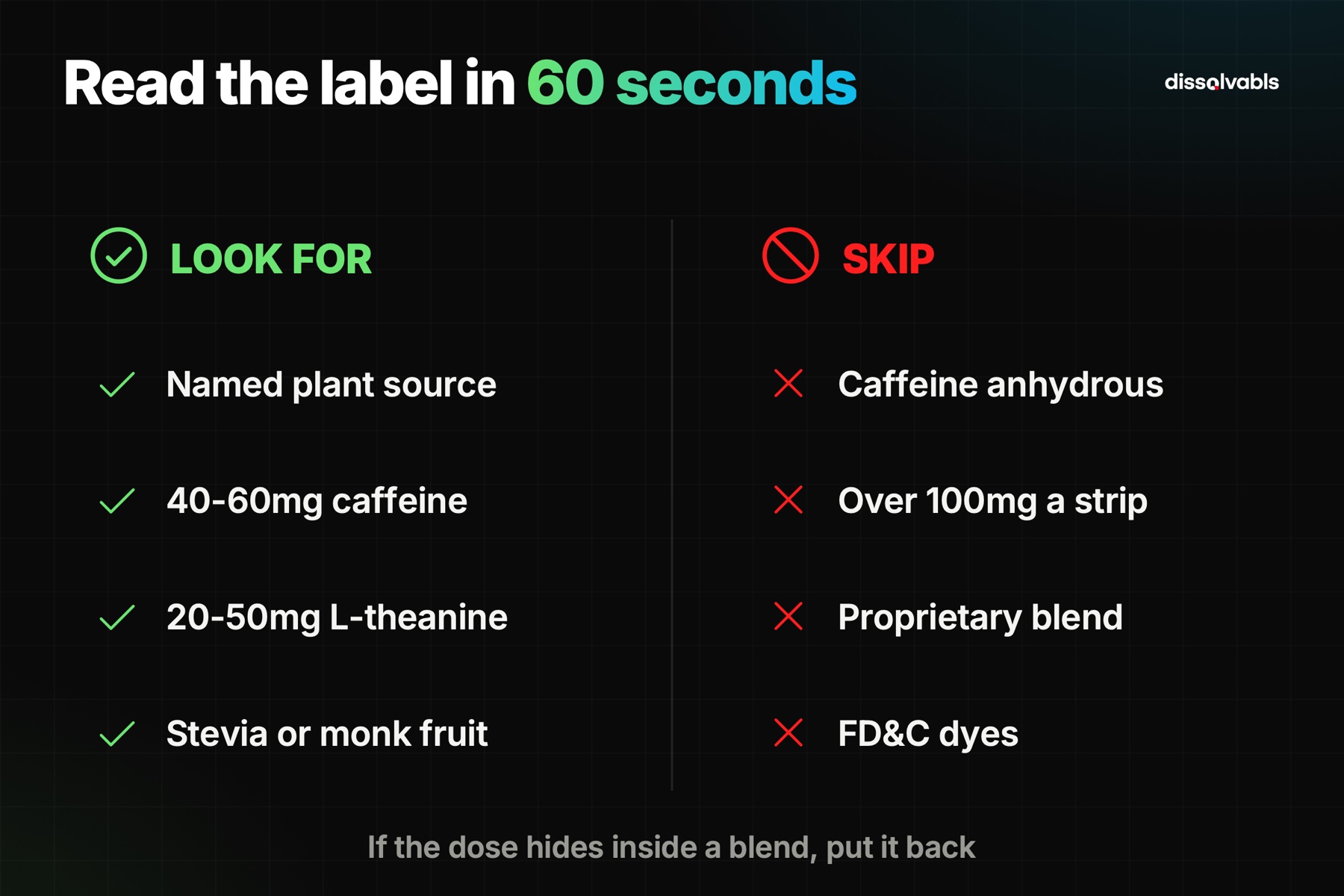
Caffeine source matters: Unlike synthetic caffeine, green coffee bean extract releases energy more gradually, reducing the risk of jitters or crashes. Look for "natural caffeine" or a named plant source on the label.
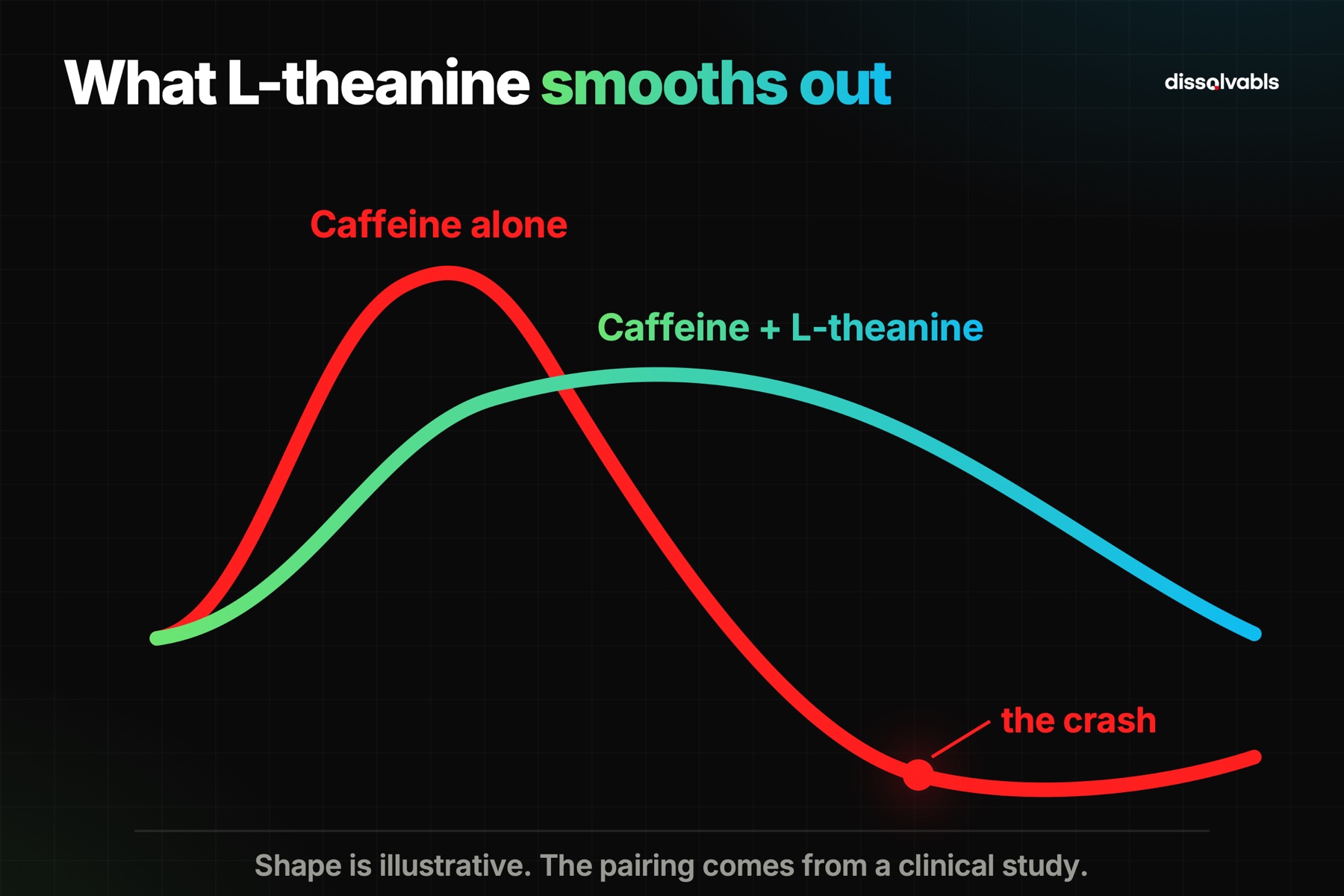
L-theanine is the difference-maker: When taken together, caffeine and L-theanine can balance each other out, mitigating the jittery effects of caffeine while aiding its positive impacts on focus and mental clarity. A strip without it is a raw caffeine hit.
50mg is the sweet spot: Look for energy strips that combine caffeine, ideally 40-60mg, for alertness and reaction time, paired with L-theanine, 20-50mg, to smooth the edges and keep you focused. That range gives you a real lift without blowing your daily budget.
Skip the dyes: Over the past five decades artificial food dye consumption has increased by 500 percent, and the majority of artificial dye intake in the United States comes from beverages like juices, energy drinks, and sports drinks. A strip has no business being neon blue.
Know the daily ceiling: Up to 400 milligrams of caffeine a day seems safe for most adults, that's about the amount of caffeine in four cups of brewed coffee, 10 cans of cola, or two energy shot drinks. A 50mg strip leaves plenty of room for your morning coffee.
Quick-Start Prioritization Framework
| What to Check | Why It Matters | Effort | Decision Time |
|---|---|---|---|
| Caffeine source (natural vs. synthetic) | Determines how clean the curve feels | Low | 10 seconds |
| Caffeine dose (mg per strip) | Lets you manage your daily intake | Low | 5 seconds |
| L-theanine presence and dose | Separates smooth focus from jitter | Low | 10 seconds |
| Sugar content | No strip should have added sugar | Low | 5 seconds |
| Artificial colors on the ingredient list | Optional but a quality signal | Low | 10 seconds |
| Dissolve time | Affects convenience and consistency | Low | 5 seconds |
Start here if you're:
New to strips: Check caffeine dose first. Aim for 40-60mg per strip so you stay in control.
Sensitive to caffeine: Prioritize L-theanine. Look for at least 20mg alongside the caffeine dose.
Focused on clean eating: Scan the ingredient list for artificial dyes (Red 40, Yellow 5, Blue 1) and skip any that list them.
Why the Strip Format Earns Its Place in Your Routine
The afternoon slump is real. The mid-afternoon drop in motivation and productivity typically occurs around 3pm, and on average it lasts almost 29 minutes. That's nearly half an hour of the workday gone. The strip format was built for exactly this window.
Oral dissolving supplements are thin, edible strips that release nutrients on the tongue without water or the need to swallow a traditional pill. The convenience is the entire point. Strips go in a wallet, a pocket, a car console, anywhere. No planning, no bottle, no preparation needed.
But convenience means nothing if the formula is bad. The strip format is a delivery vehicle, not a nutritional free pass. A strip loaded with synthetic caffeine, no L-theanine, artificial dyes, and hidden sugars will give you the same jagged spike-and-crash as anything else. The format is clean. The formula has to earn that reputation separately.
The Difference Between a Strip and a Clean Strip
Worth saying up front: not every strip on the market is made the same. It's good practice to look at the formulation, ingredients, and independent testing before choosing a brand.
In my experience, the biggest rookie mistake is assuming "strip" automatically means clean. It does not. The thin-film format can carry synthetic caffeine, artificial sweeteners, FD&C dyes, and fillers just as easily as a gummy can. You still have to read the label.
Pro Tip: Flip the strip packet over before you buy. If the active ingredient list runs longer than five items and you can't pronounce three of them, that's a signal to keep looking.
What to Look For: The Label Checklist
Caffeine Source and Amount
Not all caffeine is identical in how it feels. Many people report that organic caffeine provides a smoother energy boost, with fewer side effects like anxiety and crashes, compared to synthetic caffeine, which can lead to jitters and rapid energy spikes. On a label, synthetic caffeine often appears simply as "caffeine anhydrous." A natural source will name the plant, green coffee, green tea, guarana.
A green coffee bean is simply a fresh coffee bean that hasn't been roasted. The green part of its name comes from the fresh bean's natural pigmentation. Similar to how fresh fruits and vegetables have more intact and diverse nutrients than cooked versions, the green coffee bean contains many healthful compounds that are lost in the traditional roasting process.
The dose number is just as important as the source. Up to 400 milligrams of caffeine a day seems safe for most adults. A strip at 50mg uses just 12.5% of that ceiling per dose, giving you a controlled lift without stacking yourself into overstimulation territory. Strips landing above 100mg per piece deserve more caution, especially if you've already had coffee that morning.
L-Theanine: The Ingredient Most Strips Skip
This is the one. L-theanine, an amino acid found in tea leaves, promotes relaxation and reduces stress by modulating neurotransmitter activity, while caffeine, a well-known stimulant, increases alertness and energy levels by blocking adenosine receptors in the brain.
The research behind this pairing is solid. The combination of moderate levels of L-theanine and caffeine significantly improved accuracy during task switching and self-reported alertness, and reduced self-reported tiredness. That's from a published clinical study, not a brand's marketing page. Clinical research confirms this combination improves attention, sharpens reaction time, and significantly reduces jitters compared to caffeine alone.
In practice, what you feel is a lift that arrives without the edge. Focused rather than frantic. The dose on a strip label should sit somewhere in the 20-50mg range for L-theanine alongside your caffeine. Less than 20mg is cosmetic. More than 50mg and you're fine, but you're past the studied sweet spot.
Sugar and Artificial Colors
A sugar free energy strip should be exactly that. No added sugars. Energy drink crashes usually come from several combined mechanisms, including blood sugar spikes from high sugar content, caffeine rebound when accumulated adenosine floods receptors after caffeine clears, and dehydration from diuretic effects. A strip that sneaks in sugar defeats the entire purpose.
On the color question: in April 2025, the FDA announced plans to transition the United States from artificial food dyes to natural dyes. That move reflects growing concern about synthetic dyes. With dyes like Red 40 and Yellow 5 coloring everything from cereals to energy drinks, concerns are mounting over potential health impacts, especially in children. A strip that sits on your tongue for 10-15 seconds has no business being neon colored. Look for strips sweetened with natural options like stevia, monk fruit, or erythritol. Look for colors from fruit or vegetable sources, or no added color at all.
Pro Tip: Search the ingredient list for "FD&C" followed by any color name. That prefix tells you it's a synthetic petroleum-derived dye. If you see it, skip the product.
Dissolve Time
A strip that takes two minutes to dissolve is annoying. A strip that disappears in 10-15 seconds fits into a pre-meeting sprint or a quick stop in the stairwell. Most strips dissolve quickly on the tongue. Dissolve time can vary slightly based on saliva and mouth dryness.
Dissolve time is partly a formulation quality signal. Strips built with properly manufactured polymer film at the right thickness will dissolve fast and consistently. Brands that don't control for this tend to produce strips that clump, take too long, or leave a chalky residue.
What to Skip: Red Flags on the Label
High Caffeine With No L-Theanine
This is the most common problem in the strip category. A strip with 80-100mg of caffeine and zero L-theanine is just a fast-delivery caffeine hit. An energy drink crash is the sharp drop in energy, mood, and focus that follows the initial stimulant spike. Two main mechanisms drive the crash: caffeine rebound and blood sugar collapse. Without L-theanine to modulate the curve, you get the same boom-bust pattern in strip form.
If L-theanine is absent from the label, or listed as "proprietary blend" with no disclosed dose, treat the product as a raw caffeine strip and price it accordingly. That might be fine for a specific use case. It should just be an informed choice, not a surprise at 5pm.
Undisclosed Proprietary Blends
A "proprietary blend" label means you see the blend's total weight but not the individual ingredient amounts. This matters a lot when you're counting milligrams. Look for strips that combine caffeine, ideally 40-60mg, for alertness and reaction time. If the label hides those numbers in a blend, you cannot verify the dose. Skip it.
Artificial Sweeteners With a Bad Track Record
Stevia, monk fruit, erythritol, and xylitol are all reasonable choices for a sugar-free product. Acesulfame potassium (Ace-K) and aspartame have longer histories of consumer concern. They're not off the table, but they're worth noting if clean eating is a priority. Scan the ingredient list for them.
Pro Tip: The sweetener list on a strip is short by design. If it has more than two or three sweeteners stacked together, the brand is often masking a bitter aftertaste from low-quality caffeine or fillers. That's a formulation problem dressed up as a flavor problem.
Ginseng: The Supporting Ingredient Worth Understanding
Some energy strips add adaptogens to the formula. Ginseng is the most common. Unlike stimulants that artificially spike energy levels, ginseng acts as an adaptogen, a substance that helps the body adapt to physical and mental stress.
Some research has shown that ginseng could enhance the effects of caffeine. The mechanism differs from caffeine's direct adenosine blockade. Ginseng increases energy production in the brain as well as brain activity, as noted by higher levels of important brain neurotransmitters after ginseng consumption, including dopamine, noradrenaline, and serotonin.
At 20mg in a strip, ginseng is a supporting player, not the headline. Think of it as rounding out the formula rather than doing heavy lifting on its own. If ginseng is present at a disclosed dose, it's a positive signal for formula transparency. If it's listed but undosed in a blend, see the proprietary blend section above.
How Dissolvabls Energy Stacks Up on These Criteria
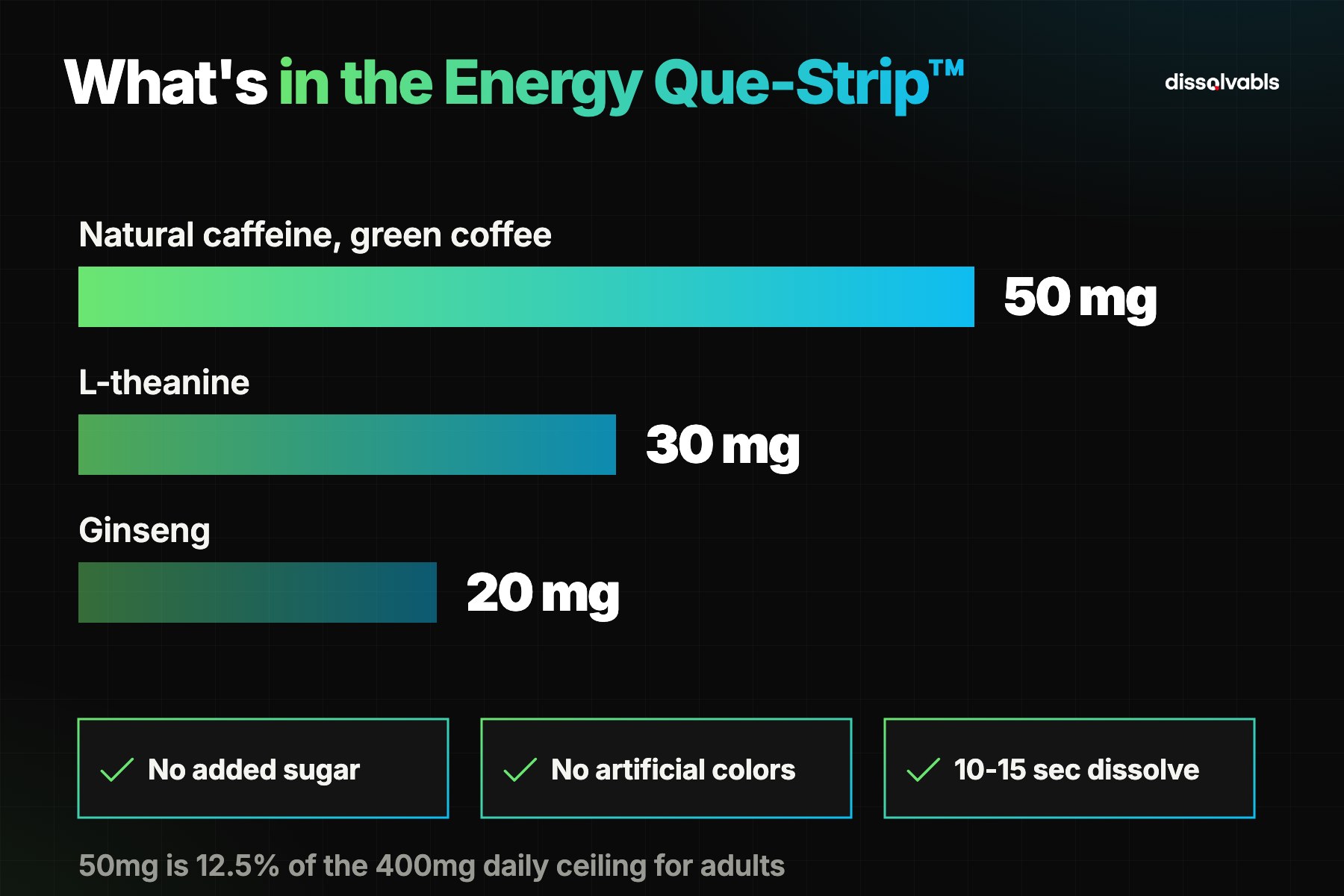
Applying this checklist to a real product is the fastest way to see how it works in practice. Dissolvabls Energy Que-Strips land at 50mg of natural caffeine from green coffee, paired with 30mg L-theanine and 20mg ginseng. The mint format dissolves in 10-15 seconds and contains no sugar and no artificial colors.
The 50mg dose is intentional. It's roughly half a cup of coffee, enough to feel a real shift in focus without burning through your daily ceiling in one strip. That dose control is the practical advantage over an energy drink, which typically delivers 150-200mg in one shot and makes it hard to calibrate how much caffeine you actually need for the next hour.
Dissolvabls positions Energy as a finish-line product for the 3pm-to-5pm stretch or the hour before a late meeting. The brand is honest that it's not an all-day solution and doesn't replace coffee. That kind of stated limit is a trust signal. A product that promises to fix everything usually delivers nothing. Dissolvabls backs the formula with a 30-day money-back guarantee, which is a reasonable way to try it without risk.
Against the checklist: natural caffeine source, disclosed dose, L-theanine present at a meaningful level, no sugar, no artificial dyes, fast dissolve. Everything that should be there is there. Nothing that should be absent is present.
Frequently Asked Questions
How much caffeine should a sugar free energy strip have?
The ideal range for caffeine in an energy strip is 40-60mg, which is enough for alertness and reaction time without overloading your system. At 50mg, a single strip lands at about half a cup of coffee. This leaves room for other caffeine sources you might have during the day. The FDA recommends keeping your daily caffeine intake below 400 milligrams, about three to four cups of coffee. If you're already drinking coffee in the morning, a lower-dose strip gives you more flexibility later in the day.
Does L-theanine actually do anything in a strip, or is it just a marketing ingredient?
The research is clear on this pairing. L-theanine has been reported to aid focus and mental clarity, and the combination of caffeine and L-theanine has been investigated in controlled trials with success and is a widely used combination within the dietary supplement industry. The key is dose. L-theanine listed in a "proprietary blend" with no disclosed amount is harder to evaluate. Look for at least 20mg explicitly listed on the label.
Are sugar free energy strips safe to use every day?
Strip-format supplements made by reputable brands and manufactured in accordance with applicable dietary supplement regulations and good manufacturing practices are designed for daily use as part of a regular wellness routine. The daily safety question mostly comes down to your total caffeine intake from all sources combined. Keep that total under 400mg for the day and you're within the guidance most health authorities use. If you have a heart condition, are pregnant, or take medications, talk to your doctor first.
What are artificial dyes doing in an energy product, and should I care?
The FDA's plans to phase out artificial color additives in foods and drinks extend to the end of 2026. That regulatory shift reflects genuine scrutiny. "If you are looking to avoid artificial dyes, be aware of ingredient lists," according to UAB dietitian Lizzy Davis. A strip that melts on your tongue is in direct contact with your oral tissue. That's a reasonable place to apply a higher standard for ingredient quality. Natural colorings from beet, spirulina, or fruit juice are available alternatives.
What is the difference between "dissolve time" and quality?
Dissolve time reflects film formulation precision. A well-made strip uses the right polymer-to-active-ingredient ratio and dissolves cleanly in 10-15 seconds. A poorly made one may take 60-90 seconds, clump, or leave residue. Most strips dissolve quickly on the tongue, and dissolve time can vary slightly based on saliva and mouth dryness. If the brand doesn't state a dissolve time anywhere in its marketing, that's worth noting. Brands confident in their manufacturing usually lead with it.
Sources
Best Energy Strips 2025, Slaps & Co. Ingredient and formulation guide for energy strips. https://www.slapsandco.com/blogs/news/best-energy-strips-2025
L-Theanine and Caffeine: How This Combination Affects Focus, Ubie Health. Evidence-based review of caffeine and L-theanine pairing. https://ubiehealth.com/doctors-note/l-theanine-caffeine-focus-anxiety-neuro-science-4262q2
The Combination of L-Theanine and Caffeine Improves Cognitive Performance, PubMed / NCBI. Clinical study, 2010. https://pubmed.ncbi.nlm.nih.gov/21040626/
The Physiologic Benefits of Caffeine and L-Theanine, University of Memphis / Acta Scientific Nutritional Health, 2024. https://www.memphis.edu/healthsciences/pdfs/2024-caffeine-l-theanine-asnh.pdf
What are the effects of combining Caffeine and L-Theanine?, Cadence. https://us.usecadence.com/blogs/science/what-are-the-effects-of-combining-caffeine-and-l-theanine
Green Coffee Bean Extract Benefits, OmniActives. Science-backed overview. https://omniactives.com/blog/green-coffee-bean-extract-benefits-and-where-to-get-it/
The Power of Green Coffee Bean: A Natural Energy Boost, Designer Wellness. https://designerwellness.com/blogs/news/the-power-of-green-coffee-bean-a-natural-energy-boost
The Truth About Food Dyes, UAB Medicine / University of Alabama at Birmingham. https://www.uabmedicine.org/news/the-truth-about-food-dyes/
Are Food Dyes Unhealthy?, MD Anderson Cancer Center. https://www.mdanderson.org/cancerwise/are-food-dyes-unhealthy.h00-159775656.html
Caffeine: How Much Is Too Much?, Mayo Clinic. https://www.mayoclinic.org/healthy-lifestyle/nutrition-and-healthy-eating/in-depth/caffeine/art-20045678
Keeping Your Caffeine in Check, OSF Healthcare. https://www.osfhealthcare.org/blog/is-caffeine-bad-for-you
Why Energy Drinks Cause Crashes, Bucked Up. https://blog.buckedup.com/2026/05/13/why-energy-drinks-cause-crash/
Oral Dissolving Supplements: A Complete Guide, BIOSTRIPS. https://biostripshealth.com/blogs/news/oral-dissolving-supplements
Dissolvable Oral Strips Guide, Halea Life. https://www.halealife.com/blogs/healthy-living/dissolvable-oral-strips
The Benefits and Risks of Ginseng for Energy and Mental Clarity, Outlook India. https://www.outlookindia.com/xhub/supplements-critic/the-benefits-and-risks-of-ginseng-for-energy-and-mental-clarity
Ginseng: Benefits and Side Effects, WebMD. https://www.webmd.com/diet/supplement-guide-ginseng
Afternoon Slump Survey Data, Study Finds / Malay Mail. https://malaymail.com/news/life/2024/01/06/survey-at-work-motivation-often-wanes-in-the-middle-of-the-afternoon/110886
Dissolvabls Energy Que-Strips, Dissolvabls. https://dissolvabls.com/