Caffeine Pills vs Coffee: What Actually Gets You Through 3pm
Caffeine pills vs coffee for the 3pm slump: speed, absorption, cost, and focus. Learn which format actually gets you through late afternoons.
The clock hits 3pm and something shifts. Your focus softens, your sentences take longer to form, and you're staring at the same paragraph you read 20 minutes ago. Seventy-one percent of workers agree the late afternoon is the worst time for work, with productivity plummeting between 3 and 6 p.m., according to a Slack survey of more than 10,000 desk workers and executives. That's a lot of people reaching for something to get them across the finish line.
The two most common options are the ones sitting on desks and in kitchen cabinets everywhere: a fresh cup of coffee or a caffeine pill. Both work. Both have real trade-offs. And depending on what the next two hours actually require, one will serve you better than the other. This guide breaks down how each format behaves at 3pm specifically, not in the abstract, and introduces a third format that's worth knowing about if speed and dose control matter more than ritual.
Key Takeaways
The 3pm slump is biological, not a willpower problem. The afternoon slump is a temporary dip in energy, alertness, and cognitive performance rooted in circadian biology. The human body's internal clock naturally programs two periods of peak sleepiness: one in the middle of the night and a smaller one in the early afternoon. Caffeine manages the symptom; it doesn't fix the root cause.
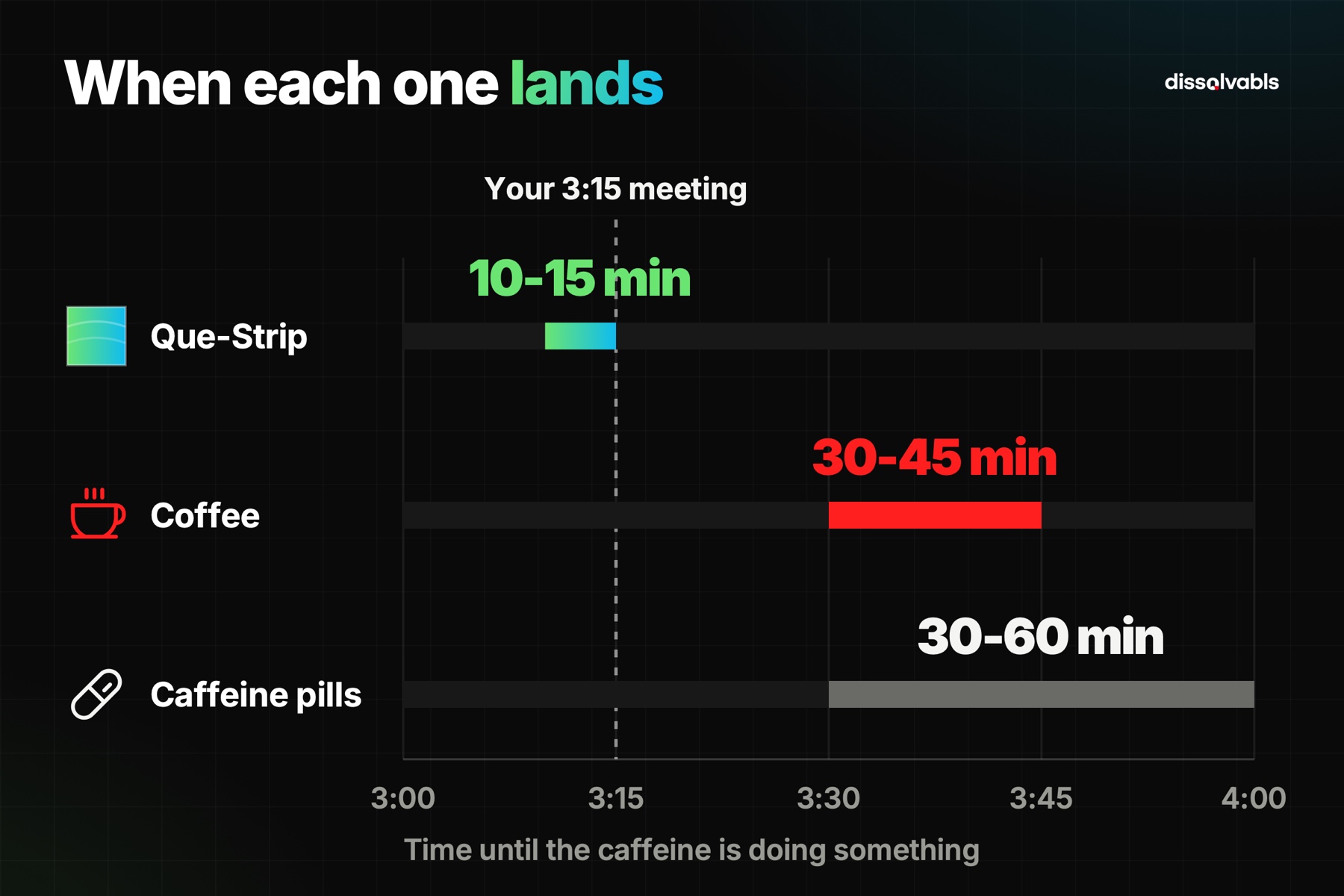
Coffee's onset window is variable. Coffee generally takes between 30 and 45 minutes to kick in, partly because you're sipping it gradually and partly because your stomach needs to process the liquid first. At 3pm, that means you might not feel anything useful until 3:45, which eats into your most valuable window.
Caffeine pills cost almost nothing, but carry a real dose risk. Caffeine pills offer cost savings of roughly $0.05 per dose vs. $2-6 per coffee, but since pills need to pass through your digestive system, they take up to 30 to 60 minutes to kick in, and it's easy to take multiple pills, leading to excessive caffeine intake and potential jitteriness.
A smaller, faster dose is often the smarter 3pm call. Caffeine crashes happen when plasma caffeine drops rapidly after a peak. Dose size matters: a higher dose creates a higher peak and a steeper drop. A 200 mg caffeine pill creates a much higher peak than a 50 mg dose. For one focused hour, less can be more.
Sleep starts paying the bill for afternoon caffeine. For the average healthy adult, the half-life of caffeine is approximately 5 to 6 hours. If you drink a large latte at 3:00 PM, by 9:00 PM 50mg of that caffeine is still circulating in your brain, and by 3:00 AM, 25mg is still active. Size your afternoon dose accordingly.
Quick-Start Prioritization Framework
| Format | Best For | Effort Level | Time to Effects |
|---|---|---|---|
| Dissolvabls Que-Strips, Best Overall | Doers who need a fast, controlled 50mg hit to finish the 3pm-5pm stretch | Low | 10-15 min |
| Regular Coffee | People who want ritual, antioxidants, and don't need to be precise | Medium (brew time) | 30-45 min |
| Caffeine Pills | Budget-conscious people who plan 45+ min ahead | Very Low | 30-60 min |
Start here if you're:
In a meeting in 15 minutes: A dissolvable strip, it's fast, quiet, and leaves no cup on the table.
Working from home with a full kitchen: Brew a cup of coffee; the ritual itself helps more than people admit.
Tracking spend tightly: Caffeine pills are the cheapest option per dose, as long as you plan ahead.
How Each Format Actually Works
The Problem With Coffee at 3pm
Coffee is honest about what it is: a slow-release ritual. Coffee delivers 80 to 200 mg per 8 oz cup depending on brew method and bean variety, with most drip coffee landing around 95 mg. The variance is the key problem: your cup could be 80 mg or 170 mg, and you cannot tell the difference by taste.
That unpredictability matters more at 3pm than it does at 8am. In the morning, you have margin for error. At 3pm, you're working with a 90-minute window before the day starts wrapping up. Coffee takes between 30 and 45 minutes to kick in, partly because of gradual sipping and partly because your stomach needs to process the liquid. By the time you actually feel it, you may have already pushed through the hard part on fumes.
There's also the sleep math to consider. Caffeine's half-life averages 5 hours but ranges from 1.5 to 9.5 hours depending on genetics. Research shows that even 6 hours before bed, 400 mg of caffeine significantly disrupts sleep. A strong 3pm coffee with a 10pm bedtime means caffeine is still doing its thing while you're trying to wind down. That's worth knowing.
Pros:
Rich in antioxidants and natural plant compounds absent in pills or strips
The preparation ritual has real psychological value
Variable dose lets you customize (half cup, double shot, etc.)
Cheapest per-serving when brewed at home
Cons:
30-45 minute onset window makes precise timing difficult
Caffeine dose per cup varies widely by brew and bean
Acidic compounds can irritate the stomach in some people
A 3pm cup carries meaningful sleep risk, depending on your bedtime
The Case for Caffeine Pills (And Their Honest Limits)
Caffeine pills deliver a fixed 100 to 200 mg hit every time. They offer precise dosing without brewing time, helping improve exercise performance and focus. That consistency is genuinely useful if you know your tolerance and plan ahead.
The cost angle is real. Home-brewed coffee costs approximately $0.25 to $0.50 per cup, while caffeine pills come in at just $0.03 to $0.10 per dose. For doers on a tight budget, that difference adds up fast across a month.
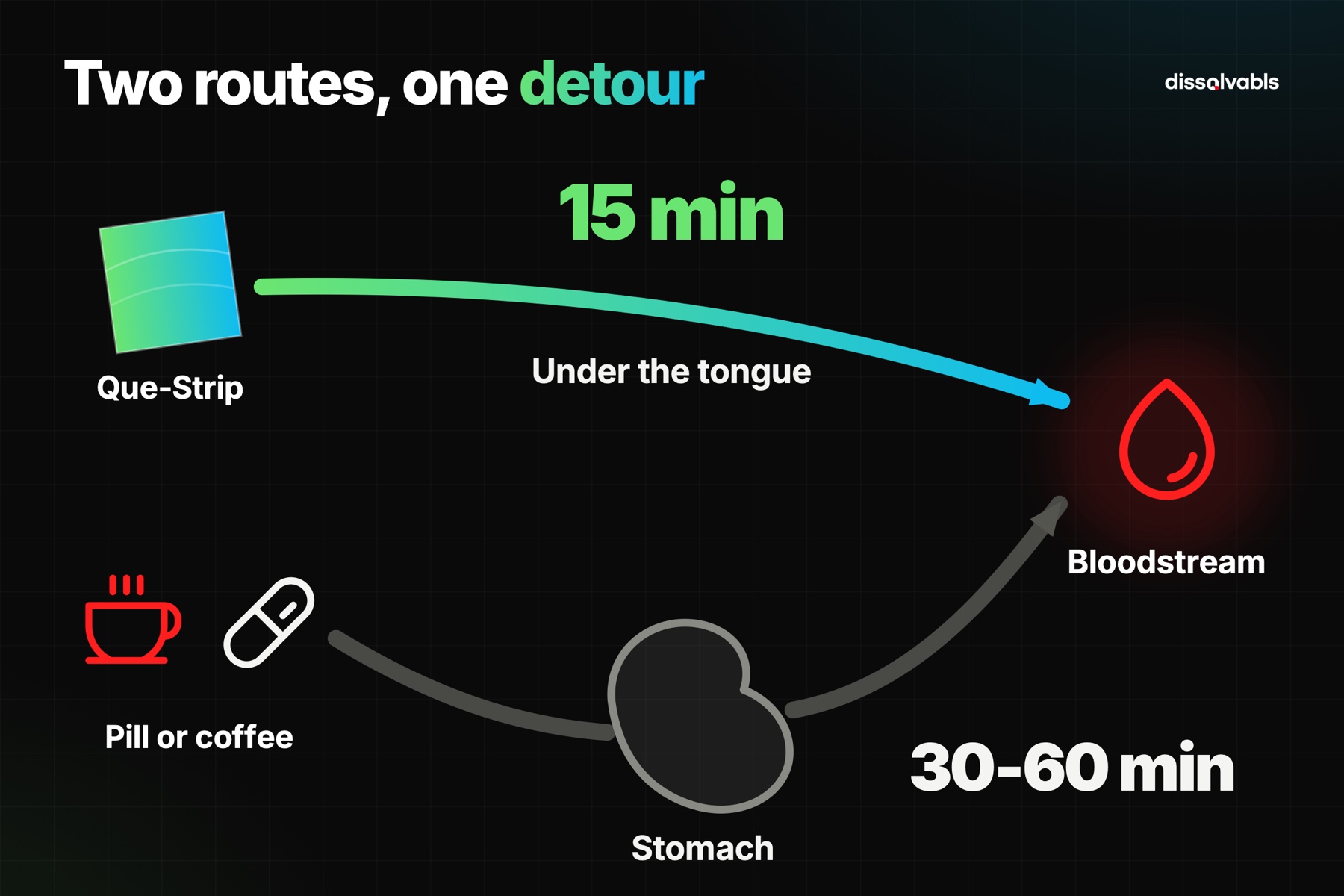
The catch: since caffeine pills need to pass through your digestive system first, they take longer, up to 30 to 60 minutes, to kick in. Pop one at 3pm and you might not feel it until 3:45 or 4:00. That's fine if the work you need to finish runs until 5pm. It's less useful if you have a 3:30 video call that needs you sharp right now.
Pro Tip: If caffeine pills are your go-to, take them at 2:30 instead of 3:00. The 30-60 minute onset window means timing is everything, and a 30-minute head start turns a mediocre tool into a reliable one.
Pros:
Lowest cost per dose of any caffeine format
Precise, consistent dosing, no guesswork
No brewing, no cup, no cleanup
Stomach-friendly for those sensitive to coffee's acidity
Cons:
Slow onset, 30 to 60 minutes before you feel anything
Standard doses (100-200 mg) may be more than you need for one afternoon hour
No antioxidants or additional plant compounds
Easy to over-consume if you forget a dose and double up
What Is Green Coffee Extract (And Why It's in Some of These Products)?
Green Coffee vs Regular Coffee
Before we go further, it's worth understanding the ingredient showing up in newer caffeine formats, including dissolvable strips. Green coffee is made from raw unroasted coffee beans. Drinks made from green coffee beans usually contain less caffeine than traditional coffee.
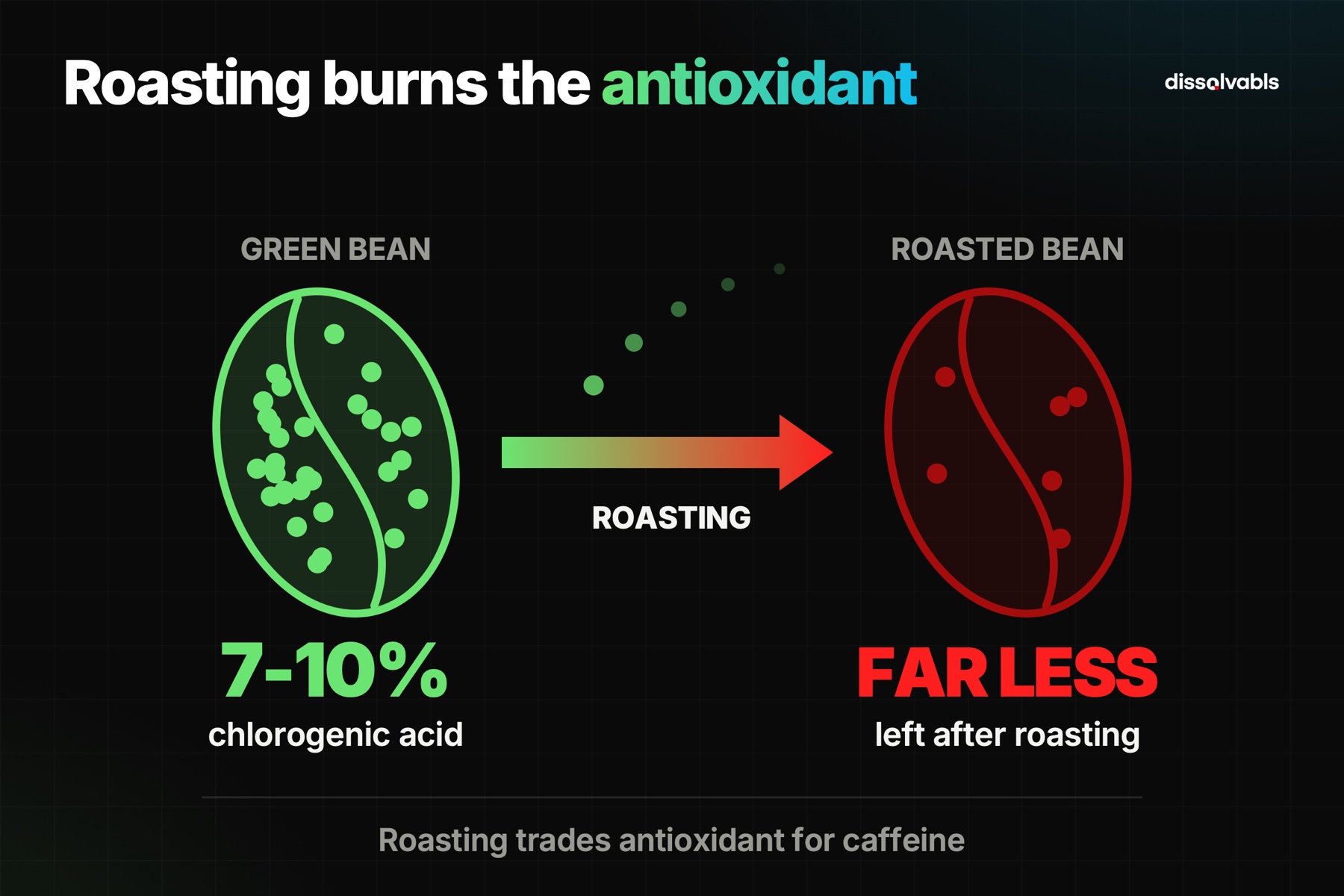
Here's the key difference: roasting destroys chlorogenic acid, a natural antioxidant compound. Research shows the highest content of chlorogenic acid is found in green coffee, while the highest caffeine content comes from medium-roasted coffee. There is a negative correlation between chlorogenic acid levels and the degree of roasting. In simple terms, roasting coffee to get that familiar flavor burns off much of the antioxidant you'd otherwise get. Green coffee beans are rich in chlorogenic acid, containing between 7-10% CGA by weight, while roasted coffee beans contain significantly less due to degradation during roasting.
Green Coffee Extract Benefits and Side Effects
Green coffee extract (GCE) has been studied for several potential benefits. Green coffee extracts have shown effects on body mass, blood glucose, lipid levels, and blood pressure. That said, honest coverage requires the full picture: research remains very limited with too many variables and no long-term studies.
Green coffee extracts are used for various reasons, but their benefits for any use are not well defined. Common side effects are caused by their caffeine content and include nervousness, trouble sleeping, an increased need to urinate, or an upset stomach. So if you're caffeine-sensitive, green coffee extract isn't a free pass; it still contains caffeine, just in a different ratio with other compounds.
The practical upside: natural caffeine from green coffee delivers the alertness effect you're after, often with a smoother feel than synthetic anhydrous caffeine found in most pills. That's why it appears in formats designed for precise, low-dose delivery.
The 3pm Head-to-Head: Onset, Dose, and Convenience
Onset Time
This is where format differences hit hardest. Caffeine absorption speed directly affects how you experience the focus boost. Pills take 30-60 minutes for gradual onset, while coffee takes 20-45 minutes and is highly variable based on food in your stomach, brew method, and individual metabolism.
By contrast, formats that dissolve on the tongue and absorb through the oral mucosa work on a different timeline. A study published in the British Journal of Clinical Pharmacology found that caffeine administered via buccal absorption reached detectable blood levels within 5 minutes and achieved significant plasma concentrations by 15 minutes, substantially faster than oral caffeine ingestion, which takes 30-45 minutes to peak. That's the difference between being ready for your 3:15 meeting and still waiting for your coffee to kick in.
Dose Control
The FDA recommends that healthy adults limit their caffeine intake to a maximum of 400 milligrams per day, equivalent to about 4 or 5 cups of coffee. Most people don't come to 3pm fresh. There's morning coffee, maybe a midday top-up, and a cumulative total that's already partway to that ceiling.
A 200mg pill at 3pm might push you close to or over that threshold, especially if your morning was heavy. A 50mg dose, roughly half a cup of coffee's worth, gives you the hour you need without stacking too much toward sleep disruption.
Convenience Cost
Portability matters as much as speed. Strips and similar compact formats pack flat with no spill risk, no cup, and no need for hot water, which is why they show up more in gym bags and carry-ons. Coffee requires infrastructure: a machine, water, a cup, and usually a few minutes you don't always have.
Caffeine pills sit closer to strips on the convenience scale, no liquid required, but the slower onset means you're still trading time for savings.
Pro Tip: The 3pm window is roughly 90 minutes long. Match your format to your timeline. If you need to be on in 10 minutes, a fast-dissolving strip is the only format that actually fits.
The Third Option: Dissolvabls Que-Strips (Best Overall for the 3pm Finish Line)
Dissolvabls makes Que-Strips, thin dissolvable films that melt on the tongue in 10 to 15 seconds. The Energy formula contains 50mg of natural caffeine sourced from green coffee. That's roughly half a cup of coffee's worth of caffeine, and that framing is intentional.
Que-Strips aren't positioned as an all-day solution. I've found this kind of honesty refreshing: the product is built for the 3pm to 5pm stretch, or the hour before a late meeting. It's a finish-line tool. You take what the next hour actually needs, not a full 200mg bomb that pushes you past your daily ceiling and costs you sleep.
The dissolvable format means the caffeine absorbs under the tongue, which gives it a noticeably faster onset than swallowing a pill or waiting on a cup of coffee to brew and process. You drop a strip, let it dissolve in seconds, and you're in the window within 10 to 15 minutes. No cup to carry. No machine to find. No bathroom trip 20 minutes later from a full 12-ounce drink.
The green coffee source also means you're getting natural caffeine alongside some chlorogenic acid compounds rather than synthetic anhydrous caffeine. For people who've noticed jitters on high-dose pills, the smaller, naturally sourced dose tends to sit differently.
Best for: Doers who need to cover the last stretch of the workday with a precise, low dose they can take anywhere, at a desk, in a car, between back-to-back meetings, without the logistics of coffee or the waiting game of a pill.
Dissolvabls also backs the product with a 30-day money-back guarantee, which is the right call for any format someone hasn't tried before.
Pros:
50mg natural caffeine from green coffee, purpose-built for one hour, not all day
Dissolves in 10-15 seconds, absorbs under the tongue fast
No cup, no water, no brewing
Low-dose format reduces risk of jitters, crash, and sleep disruption
30-day money-back guarantee
Cons:
Higher cost per dose than caffeine pills
50mg dose isn't enough for people with high caffeine tolerance who need a larger hit
No antioxidant ritual that coffee offers
Novelty format that some people need to get used to
Pro Tip: If you're a nurse, a parent on the school run, or anyone stuck in a late-day obligation without access to a kitchen or a cafe, a strip in your pocket is more reliable than hoping there's a coffee machine nearby.
Common Mistakes to Avoid With Afternoon Caffeine
Chasing the Slump With Too Much
The instinct when tired at 3pm is to reach for the biggest, strongest thing available. That usually means a large coffee or a double-dose of pills. The problem: caffeine crashes happen when plasma caffeine drops rapidly after a peak, and higher doses create higher peaks and steeper drops. You get 90 minutes of sharpness and then a harder fall than you started with.
A smaller, precise dose covers the hour you need without setting up the crash at 5pm.
Ignoring the Sleep Math
One study found that consuming caffeine 6 hours before bedtime reduced total sleep time by 1 hour. In my experience, most people know this in theory and ignore it in practice. If your bedtime is 10pm, a strong cup of coffee at 3pm is already cutting it close. A 200mg pill is riskier still.
The math favors smaller doses later in the afternoon. 50mg absorbed quickly is gone from your system faster than 200mg still sitting in your gut at 7pm.
Relying on Format Instead of Fixing the Root
Drowsiness in the late afternoon is part of the body's normal circadian rhythm, which dips significantly between 2 and 5 p.m., according to the National Sleep Foundation. Caffeine manages that biological dip. It doesn't erase it. If the slump is consistent and severe, look at sleep quality, hydration, and lunch composition before increasing your caffeine dose.
Frequently Asked Questions
How does green coffee extract work differently from regular coffee caffeine?
Green coffee extract comes from unroasted beans, which means it retains higher levels of chlorogenic acid alongside caffeine. Research shows the highest content of chlorogenic acid is found in green coffee, while roasted coffee has higher caffeine due to the concentration effect of roasting. In practical terms, natural caffeine from green coffee tends to deliver alertness with less of the sharp spike associated with synthetic caffeine anhydrous found in most pills. The key difference is the compound profile around the caffeine, not the caffeine molecule itself.
Is it safe to take caffeine pills every day?
Up to 400 milligrams of caffeine a day appears safe for most adults, about the amount in four cups of brewed coffee, 10 cans of cola, or two energy shot drinks. The daily limit is the same regardless of format. The risk with pills specifically is that a single standard pill (100-200mg) can push someone to their ceiling quickly when combined with morning coffee. Track your total daily intake across all sources, not just the pill.
Does a dissolvable strip really work faster than coffee?
The format does matter for onset. A study in the British Journal of Clinical Pharmacology found that caffeine delivered via buccal absorption reached detectable blood levels within 5 minutes and significant plasma concentrations by 15 minutes, substantially faster than oral caffeine ingestion at 30-45 minutes to peak. Coffee's onset is also slowed by the fact that you're sipping it across several minutes, not taking a fixed dose at a single point. For strict 3pm timing, a dissolvable strip has a real-world advantage over both a pill and a cup.
Will a 3pm cup of coffee ruin my sleep?
It depends on your dose and your individual caffeine metabolism. Caffeine has a half-life of anywhere between 2 and 12 hours, which varies widely by genetics and age. Research shows that even 6 hours before bed, 400 mg of caffeine significantly disrupts sleep, and most people need 8-13 hours for complete clearance. A small dose (50mg) at 3pm with a 10pm bedtime is a much lower risk than a full 200mg cup.
What's the difference between caffeine strips and caffeine gum?
Both formats absorb through the oral mucosa rather than the digestive system. The primary difference is contact time and form factor. A format held for 15 to 20 minutes gives caffeine sustained contact time with the oral mucosa, which is the mechanism behind faster, smoother onset. Strips dissolve in seconds and are more discreet. Gum requires chewing and can linger longer than intended. For a 3pm office or work-from-home setting, a dissolving strip tends to be less obtrusive.
Conclusion
Coffee is a great morning format and a reasonable midday option. At 3pm, its slow, variable onset starts working against you. Caffeine pills solve the dose consistency problem and save money, but they're only useful if you plan 30 to 60 minutes ahead, which most people don't. A dissolvable strip at 50mg hits the window you actually need: fast enough to matter, small enough not to wreck your sleep, and portable enough to use anywhere.
If the 3pm-to-5pm stretch is where your day either gets finished or falls apart, choose your format with that stretch in mind. Try Dissolvabls Que-Strips with their 30-day money-back guarantee and see where 50mg of green coffee caffeine lands you.
Sources
Slack Workforce Productivity Survey, Salesforce/Slack & Qualtrics. Survey of 10,000+ desk workers on afternoon productivity dips. https://www.cnbc.com/2023/12/14/the-worst-time-of-day-to-be-productive-according-to-new-slack-research.html
Caffeine Pills vs Coffee Full Comparison, CoffeeMasterHub. Onset timing and format comparison guide. https://coffeemasterhub.com/caffeine-pills-vs-coffee/
Caffeine Pills vs Coffee: Which Offers Precise Dosing?, Bones Coffee. Dose precision, pros and cons breakdown. https://www.bonescoffee.com/a/blog/caffeine-pills-vs-coffee
Green Coffee: Overview, Uses, Side Effects, WebMD. Green coffee extract benefits, side effects, and safety profile. https://www.webmd.com/vitamins/ai/ingredientmono-1264/green-coffee
Green Coffee Bean Extract Risks and Benefits, Cleveland Clinic. Clinical perspective on GCE research limitations. https://health.clevelandclinic.org/green-coffee-bean-extract
Quantification of Caffeine and Chlorogenic Acid in Green and Roasted Coffee, NIH/NCBI. HPLC analysis of chlorogenic acid loss during roasting. https://www.ncbi.nlm.nih.gov/pmc/articles/PMC8705492/
Green Coffee Beans vs. Roasted Coffee Beans, Of The Gods. CGA content comparison between green and roasted beans. https://drinkotg.com/blogs/energy-focus/green-coffee-beans-vs-roasted-coffee-beans
Sublingual Caffeine Absorption: Is It Faster?, Roon/Takeroon. Pharmacokinetics of buccal vs oral caffeine. https://www.takeroon.com/blog/sublingual-caffeine-absorption-pharmacokinetics
Do Caffeine Pouches Work? Science Explained, Nectr Energy. Buccal absorption onset data and British Journal of Clinical Pharmacology citation. https://nectr.energy/blogs/life-hacks/do-caffeine-pouches-work-science-explained
Caffeine Pills vs Coffee 2026: Which is Better?, FormulaCompare. Cost per dose comparison and performance breakdown. https://formulacompare.com/blog/caffeine-pills-vs-coffee.html
Caffeine Pouches vs Coffee vs Energy Drinks, Cream.energy. Comprehensive cost comparison across caffeine formats. https://cream.energy/en/blogs/caffeine-pouches/caffeine-pouches-vs-coffee-vs-energy-drinks
Are Dissolvable Energy Strips Better Than Caffeine Pills?, Ark of Sweden. Portability, onset, and format comparison. https://arkofsweden.com/en-us/blogs/news/energy-strips-vs-caffeine-pills
Caffeine and Sleep Problems, Sleep Foundation. Half-life data and afternoon caffeine sleep risk. https://www.sleepfoundation.org/nutrition/caffeine-and-sleep
Coffee and Sleep: How Late Is Too Late?, Ember Coffee. Genetic variation in caffeine half-life and sleep disruption research. https://embercoffee.co/blogs/learn/how-long-coffee-affects-sleep
Caffeine Half-Life and Sleep, Hush Home. 3pm latte math and adenosine impact explained. https://www.hushhome.com/blogs/sleep-wellness-guide/caffeine-half-life-and-sleep
Sleep and Caffeine, Sleep Education (American Academy of Sleep Medicine). 6-hours-before-bedtime research and sleep reduction data. https://sleepeducation.org/sleep-caffeine/
Caffeine: How Much Is Too Much?, Mayo Clinic. 400mg daily limit and side effect guidance. https://www.mayoclinic.org/healthy-lifestyle/nutrition-and-healthy-eating/in-depth/caffeine/art-20045678
Caffeine Pills vs. Caffeine Oral Dissolving Strips in 2025, STIM Energy. Absorption speed comparison and format mechanics. https://stim.rocks/blogs/news/caffeine-pills-vs-caffeine-oral-dissolving-strips-in-2025